
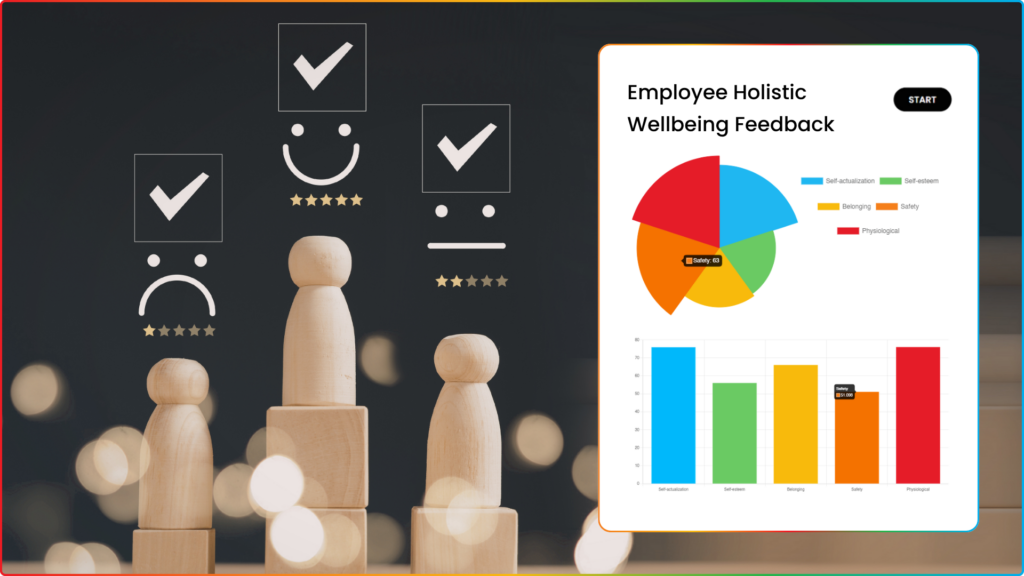
“What would change if you could measure wellbeing early enough to protect productivity, retention, safety, and performance before those KPIs begin to decline?”
A Research-Grounded Framework for Measuring What Drives Performance and Stability
Executive Summary
A substantial body of research across industrial-organizational psychology, performance science, behavioral economics, and occupational health demonstrates a consistent pattern:
Employee wellbeing predicts organizational performance.
Holistic wellbeing — encompassing physiological health, psychological safety, belonging, esteem, and purpose — is strongly associated with:
- Higher productivity
- Stronger engagement
- Lower voluntary turnover
- Reduced absenteeism and presenteeism
- Fewer safety incidents
- Greater organizational resilience
Critically, wellbeing functions as a leading indicator. By the time lagging metrics such as attrition, engagement scores, or operational errors decline, underlying wellbeing deterioration has often already occurred.
Organizations that measure wellbeing directly gain earlier visibility into workforce risk and performance volatility. This paper synthesizes the research linking wellbeing to organizational KPIs and presents a framework for operationalizing that science through structured, psychometrically validated measurement.

Wellbeing Is Holistic — and It Travels With the Individual
Much of the literature references “wellbeing at work.” That phrase is convenient, but incomplete.
Work environments shift constantly: remote, hybrid, distributed, frontline, asynchronous. Individuals move across contexts. Their wellbeing moves with them.
Holistic wellbeing is best understood as an integrated whole: psychological state, physical functioning, social relationships, family systems, working conditions, and environment. These dimensions do not exist in isolation. A change in one domain reliably affects others — which is why single-lens approaches tend to fragment the causes behind performance variability.
Maslow’s framework remains instructive here. When physiological and safety needs are compromised, cognitive bandwidth narrows. When belonging and esteem are threatened, engagement erodes. When purpose alignment weakens, discretionary effort declines.
This aligns with empirical research on the “happy-productive worker” thesis. In field studies, psychological wellbeing predicted job performance outcomes (Wright & Cropanzano, 2000).
Wellbeing is not confined to a workplace location.
It is a portable human capacity variable.

The Empirical Link Between Wellbeing and Organizational KPIs
Across studies and methodologies, the evidence converges.
At the business-unit level, a large meta-analysis found meaningful relationships between employee satisfaction/engagement and outcomes including productivity, profit, turnover, and accidents (Harter et al., 2002).
Organizational-level research likewise links workplace wellbeing with firm performance (De Neve et al., 2024).
Gallup’s research on wellbeing and engagement also reinforces the relationship between thriving employees and performance stability (Gallup, 2015).
Meta-analytic work in occupational psychology has repeatedly linked mental health and wellbeing to absenteeism, presenteeism, and risk exposure (Kelloway et al., 2023; Sarkar, 2024).
The directional pattern is clear: When wellbeing declines, risk increases. When wellbeing strengthens, capacity expands.
Why Wellbeing Operates as a Leading Indicator
Wellbeing influences organizational KPIs through identifiable mechanisms.
Engagement often mediates the relationship between wellbeing and performance at scale — meaning wellbeing shifts first, and engagement and output follow. Business-unit evidence and large-scale engagement meta-analyses support this model (Harter et al., 2002).
Psychological safety and perceived organizational support amplify discretionary effort and collaborative behavior — key precursors to quality, innovation, and performance consistency (Weziak-Bialowolska et al., 2023).
Physiological wellbeing influences decision quality, attention, and cognitive control — all critical under pressure and high workload (Adams et al., 2019).
These mechanisms operate upstream of turnover, safety incidents, and productivity decline. By the time lagging KPIs move, wellbeing erosion has often been present for months.
Financial and Strategic Implications
The financial case for wellbeing is strongest when organizations treat it as a measurable driver of stability — not a “nice-to-have.”
A widely cited meta-analysis published in Health Affairs found that workplace wellness programs were associated, on average, with about $3.27 in medical cost reductions per $1 spent and about $2.73 in absenteeism cost reductions per $1 spent (Baicker et al., 2010).
The OECD’s Promoting Health and Well-being at Work report synthesizes evidence that workplace programs improving lifestyles, health, and wellbeing can reduce sick leave absenteeism by around 25%, while also describing positive economic returns in multiple models (OECD, 2022).
Deloitte’s UK analysis (based on a review of published ROI studies) reports an average return of £4.70 for every £1 invested in employee mental health and wellbeing interventions (Deloitte, 2024).
At the macro level, the McKinsey Health Institute estimates that investing in holistic employee health could generate $3.7T to $11.7T in global economic value, largely through productivity and reduced health-related costs (McKinsey Health Institute, 2024).
None of these figures should be treated as universal guarantees for every program or organization — but collectively, they reinforce a board-level conclusion:
Wellbeing has measurable economic consequences, and it belongs in enterprise planning and risk governance.

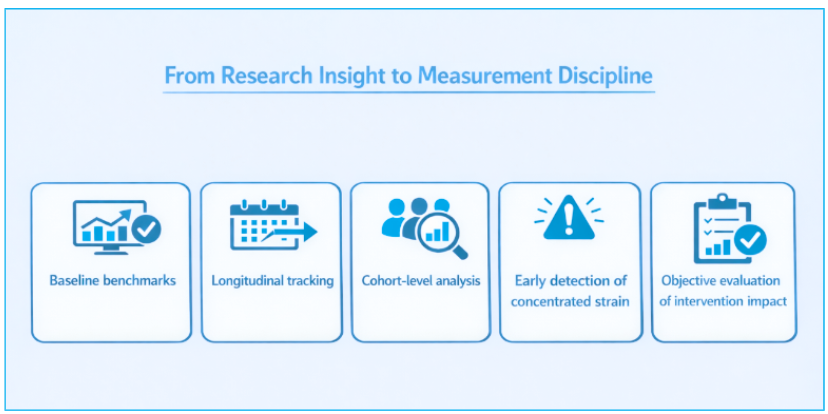
From Research Insight to Measurement Discipline
If wellbeing predicts performance, it must be measured directly.
Most organizations measure engagement.
Some measure benefits utilization.
Few measure holistic wellbeing through validated psychometric instrumentation.
Without direct measurement, leadership lacks:
- Baseline benchmarks
- Longitudinal tracking
- Cohort-level analysis
- Early detection of concentrated strain
- Objective evaluation of intervention impact
Research provides the insight. Measurement provides governance.
Pietential: Translating Research Into Enterprise Risk Intelligence
Pietential operationalizes this body of research into structured measurement.
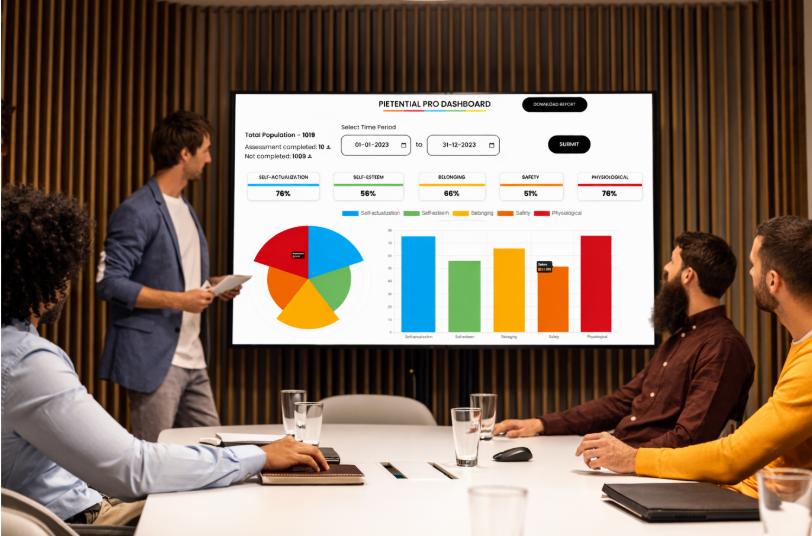
Grounded in Maslow’s integrated framework, the platform assesses wellbeing across five domains and twenty subdomains:
Physiological Needs, Safety, Belonging, Self-Esteem, Self-Actualization
These domains align with validated constructs across organizational psychology and motivational science.
The assessment is science-backed and psychometrically validated by outside psychometricians, under the oversight of Pietential’s Chief Clinical Officer.
The platform is unconflicted by commercial upsells. It does not depend on selling coaching, therapy, or ancillary services. Its core function is objective measurement clarity.
Each employee receives a private wellbeing visualization.
Leadership receives aggregated, de-identified intelligence segmented by role, tenure, geography, and function, and more.
This enables leaders to:
- Identify early risk clusters
- Detect domain-specific erosion
- Evaluate program efficacy
- Compare cohorts
- Track longitudinal change
Wellbeing research becomes enterprise risk intelligence.
Measuring What Actually Moves Performance
When organizations adjust scheduling, redesign compensation, invest in leadership development, or implement flexibility policies, the relevant question is not simply:
“Did engagement change?”
The deeper question is:
“Did holistic wellbeing improve — and for whom?”
Because if wellbeing improves, the research suggests downstream KPIs are more likely to follow.
Pietential enables before-and-after comparisons, cohort segmentation, and longitudinal tracking that allow organizations to measure movement in leading indicators rather than waiting for lagging outcomes.
Conclusion: From Correlation to Governance
The research consensus is clear: holistic wellbeing meaningfully influences engagement, retention, productivity, safety, and financial stability. Organizations that measure wellbeing directly gain earlier visibility into workforce risk, while those that do not remain dependent on trailing indicators that surface only after performance volatility has already begun to compound.
From a governance perspective, this reframes wellbeing as more than a cultural aspiration or HR initiative. It becomes a measurable leading indicator of workforce-driven operational risk. For CFOs and board members responsible for overseeing performance stability, capital allocation, and long-term value creation, disciplined visibility into the condition of the workforce is not peripheral — it is foundational.
When holistic wellbeing is assessed through structured, psychometrically sound measurement, it provides earlier insight into emerging instability, clearer evaluation of intervention impact, and stronger alignment between people strategy and enterprise performance continuity. In an environment where performance volatility carries increasing cost, leading indicators matter. Measuring wellbeing with rigor is no longer optional; it is a strategic advantage.
Research Highlights
- Psychological wellbeing predicted job performance in field studies, supporting the happy-productive worker thesis (Wright & Cropanzano, 2000).
- A business-unit meta-analysis linked employee satisfaction/engagement to productivity, profit, turnover, and accidents (Harter et al., 2002).
- Workplace wellness ROI meta-analysis: ~$3.27 medical savings and ~$2.73 absenteeism savings per $1 invested (Baicker et al., 2010).
- OECD synthesis: workplace wellbeing programs can reduce sick leave absenteeism by ~25% (OECD, 2022).
- Deloitte UK analysis: average £4.70 return per £1 invested in mental health and wellbeing interventions (Deloitte, 2024).
- McKinsey Health Institute estimates $3.7T–$11.7T global economic value potential from improved holistic employee health (McKinsey Health Institute, 2024).
References
Baicker, K., Cutler, D., & Song, Z. (2010). Workplace wellness programs can generate savings. Health Affairs, 29(2), 304–311.
Deloitte. (2024, May 17). Poor mental health costs UK employers £51 billion a year for employees.
Gallup. (2015). Employee wellbeing, engagement, and performance.
Harter, J. K., Schmidt, F. L., & Hayes, T. L. (2002). Business-unit-level relationship between employee satisfaction, employee engagement, and business outcomes: A meta-analysis. Journal of Applied Psychology, 87(2), 268–279.
Kelloway, E. K., Dimoff, J. K., & Gilbert, S. (2023). Mental health in the workplace. Annual Review of Organizational Psychology and Organizational Behavior, 10, 363–387.
McKinsey Health Institute. (2024, March 13). Working nine to thrive.
McKinsey Health Institute. (2025, January 16). Thriving workplaces: How employers can improve productivity and change lives.
OECD. (2022). Promoting health and well-being at work. Organisation for Economic Co-operation and Development.
Sarkar, S. (2024). Mental health and well-being at the workplace. Cureus, 16(2).
Weziak-Bialowolska, D., et al. (2023). Psychological caring climate and wellbeing. Social Science & Medicine, 326.
Wright, T. A., & Cropanzano, R. (2000). Psychological well-being and job satisfaction as predictors of job performance. Journal of Occupational Health Psychology, 5(1), 84–94.