
Can you actually see — objectively and at the cohort level — the human wellbeing conditions behind your workforce risk? And if not, what is that blind spot costing you in turnover, reliability, judgment, professionalism, and contract performance?
1. The human risk behind armed security
Armed security organizations operate in one of the most human-dependent segments of the labor market. Performance depends not only on staffing levels, training protocols, post orders, licensing, supervision, compliance systems, and client relationships — but on the wellbeing conditions of the people placed in safety-sensitive, public-facing, and often high-pressure roles.
Armed security personnel may be responsible for protecting people, property, facilities, schools, hospitals, commercial sites, public events, residential communities, logistics operations, and critical infrastructure. In these environments, leadership must be able to rely on the judgment, consistency, professionalism, and emotional composure of the workforce.
A security firm can have strong policies, competent supervisors, good training, and a serious compliance program — yet still lack an objective way to see whether people across its workforce are experiencing patterns of instability in their wellbeing, disconnection, fatigue, lack of belonging, low self-worth, or diminished sense of purpose. Those conditions do not automatically produce incidents. But they do shape the human environment in which judgment, retention, reliability, and performance occur.
The security officer is often the first visible line of order, deterrence, reassurance, and response. That means the organization is relying on the officer’s ability to remain calm under pressure, interpret ambiguous situations, communicate professionally, follow procedure, maintain situational awareness, exercise restraint, manage fatigue and stress, maintain trust with clients and the public, and continue showing up — in a role where turnover is often structurally high.
These are not merely wellness concerns. They are workforce risk concerns.
2. How serious is the industry pressure?
The private security industry is large, essential, and under sustained workforce pressure. The data tells a stark story.
| Challenge | Scale | Source |
|---|---|---|
| Turnover as top challenge | >40% of security service providers | ASIS International, 2025 |
| Fatal occupational injuries in protective services | 281 fatalities in 2024 | U.S. Bureau of Labor Statistics |
| Homicides as share of those fatalities | 34.5% | U.S. Bureau of Labor Statistics |
| Workplace violence | Recognized hazard area | OSHA |
Figure 1. Industry pressure indicators. Sources as listed.
For armed security firms, these pressures are intensified by the nature of the role. Turnover is not only a human resources issue. It becomes a training burden, a scheduling burden, a supervision burden, a client-service issue, a risk-management issue, and a financial issue.
When experienced officers leave, the organization loses more than labor capacity. It loses site knowledge, relationship knowledge, procedural familiarity, client trust, and informal judgment developed over time.
The question is not simply: How do we recruit more guards? The deeper question is: Can leadership see the human wellbeing conditions that may be contributing to turnover, disengagement, absenteeism, reliability issues, and avoidable risk — before those issues become visible through incidents, complaints, vacancies, or contract problems?
3. Managing human risk with mostly lagging indicators
Security firms typically track what they can see: headcount, open posts, overtime, time-to-fill, turnover, absenteeism, training completion, licensing status, incident reports, client complaints, use-of-force reports, workers’ compensation claims, contract renewals, supervisor reports, and scheduling data.
These are important management signals. But most of them tell leadership what has already happened.
| Lagging indicator | What does it tell you | What it misses |
|---|---|---|
| Turnover | Someone has already left | Why were they disengaging for months |
| Absenteeism | A shift was missed | Shifts in sleep, activity, psychological safety, or physical wellbeing |
| Post abandonment | A post was uncovered | The wellbeing erosion across the team |
| Client complaint | A client is already frustrated | Drops in psychological safety, self-confidence, or social connection |
| Incident report | An event has already occurred | The human wellbeing conditions that preceded it |
| Contract churn | A contract is at risk | Site-level declines in safety, belonging, self-esteem, or purpose |
Figure 2. Lagging indicators vs. the human conditions they miss.
The most expensive workforce problems in armed security are the ones that do not announce themselves. They accumulate quietly in cohorts with no visibility, and they surface only once they have become attrition, incidents, complaints, or contract loss — the point at which they are most costly to address.
4. What independent wellbeing intelligence actually makes visible
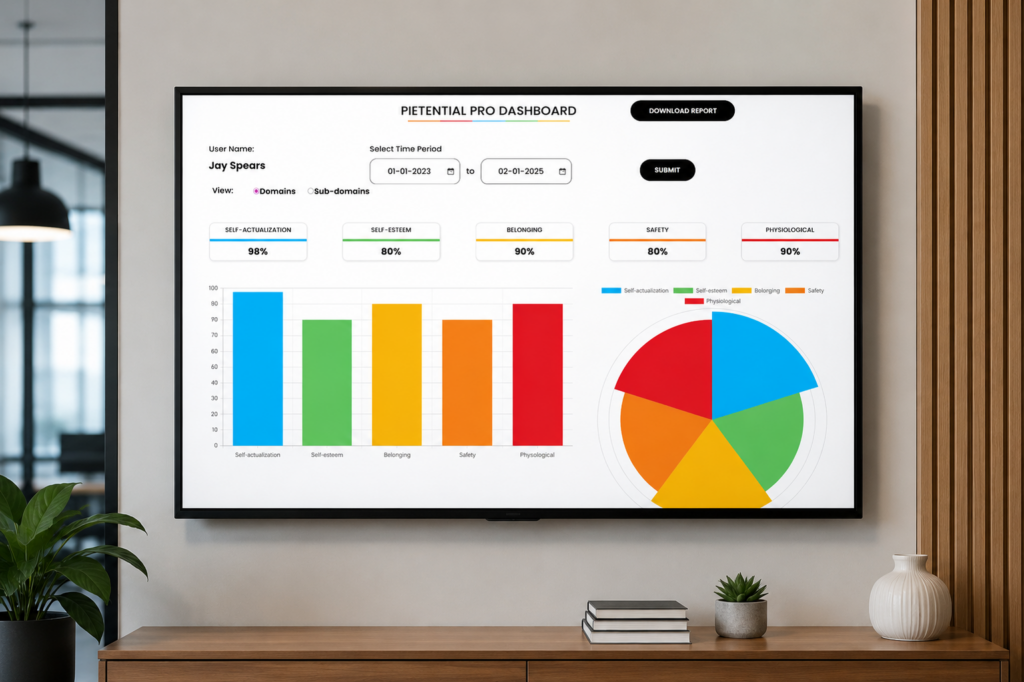
Pietential is an Independent Wellbeing Intelligence System that helps organizations assess, measure, monitor, improve, and interpret holistic human wellbeing. The platform is built around a validated wellbeing assessment model that measures five core domains of human wellbeing.
| Domain | What it measures | In armed security |
|---|---|---|
| 1. Physiological | Activity, Environment, Nutrition and Sleep | Physical health, Intentional health choices, fitness, rest, and nutritional requirements. |
| 2. Belonging | Friendships, Intimate Compassion, Family and Social Community | Supportive relationships with team, supervisors, family, and wider community that buffer job stress. |
| 3. Safety | Psychological Safety, Spiritual Safety, Dwelling Safety and Physical Safety | Secure, protected, and free from threat or intimidation. |
| 4. Self-Esteem | Self-Worth, Self-Confidence, Identity and Mastery | Confidence, recognition, secure identity, and sense of agency to achieve goals. |
| 5. Self-Actualization | Mindset, Social Curiosity, purpose and Openness | Purpose, growth, meaning in work, curiosity and openness to new experiences |
Figure 3. Five domains of human wellbeing mapped to armed security.
These domains are assessed through a brief user experience that produces immediate individual feedback for the participant and anonymized, cohort-level intelligence for the organization.
For the individual
Pietential provides a private wellbeing profile, visual results, longitudinal tracking, and guided improvement resources — delivered with full privacy.
For the organization
Pietential provides anonymized intelligence that helps leaders understand wellbeing patterns across groups, locations, functions, demographic segments, departments, sites, or time periods. In an armed security context, this means leadership can begin asking better questions:
- Are certain sites showing lower wellbeing patterns than others?
- Are overnight teams experiencing different wellbeing conditions than daytime teams?
- Are newer hires showing different wellbeing patterns from longer-tenured officers?
- Are teams assigned to higher-stress posts showing measurable wellbeing decline over time?
- Are wellbeing patterns improving after supervisor training, schedule changes, or retention initiatives?
- Are there early signals that may help leadership prioritize attention before turnover, complaints, or contract pressure increase?
5. What Pietential does not do
- Because armed security is a safety-sensitive field, it is essential to define Pietential’s role clearly.
- Pietential does not determine whether a person should carry a firearm. It does not replace background checks, licensing, training, supervision, or compliance.
- It does not serve as a fitness-for-duty evaluation, provide clinical diagnosis, identify individuals as dangerous or unstable, or predict violence.
- It does not replace EAPs, clinical services, or psychological evaluation.
- It does not give managers individual-level mental health data.
- It does not function as an employee surveillance tool.
The purpose of Pietential is not to label individuals. The purpose is to give individuals a private, useful wellbeing experience while giving leadership anonymized intelligence about workforce wellbeing patterns that may affect organizational outcomes. That is what makes the platform both useful and ethically appropriate.
6. How wellbeing intelligence connects to business outcomes
The value of wellbeing intelligence increases when it can be interpreted alongside the operational realities of the armed security business.
| Outcome area | How wellbeing intelligence helps |
|---|---|
| Retention | Explore wellbeing patterns that may be associated with elevated retention risk at the cohort level, potentially providing early insight before resignations occur. |
| Reliability | If certain teams or sites show patterns of low wellbeing, leadership may intervene earlier with supervisor support, scheduling review, or resource allocation. |
| Judgment | Understand whether the broader wellbeing conditions that support composure and decision-making are strong, weak, improving, or deteriorating across groups. |
| Professionalism | Wellbeing affects how people show up. Security personnel serve as the visible human face of the client’s safety environment. |
| Supervisor effectiveness | Understand whether certain teams, sites, or reporting lines are experiencing better or worse wellbeing outcomes — a more objective basis for coaching and operational review. |
| Contract performance | Demonstrate a serious approach to workforce wellbeing intelligence with clients in healthcare, education, corporate campuses, and critical infrastructure. |
Figure 4. Wellbeing intelligence mapped to armed security business outcomes.
7. Where wellbeing intelligence can be applied
New-hire cohort tracking
Understanding wellbeing patterns among new hires during onboarding and early assignment may help leaders identify whether early employment experiences are supporting retention or creating preventable drop-off.
Site-level comparison
Anonymized cohort data can help compare wellbeing patterns across sites and contracts. If one site shows consistently lower wellbeing indicators, leadership can investigate operational factors such as supervision, scheduling, client environment, or post conditions.
Shift and schedule analysis
Overnight, weekend, rotating, and extended shifts carry distinct human demands. Pietential helps organizations evaluate whether certain shift structures are associated with lower wellbeing patterns over time.
Retention program evaluation
When companies introduce new retention initiatives, supervisor training, pay changes, benefits communication, or employee-support programs, Pietential helps assess whether wellbeing conditions are improving among the affected cohorts.
Post-incident organizational recovery
After serious incidents, Pietential can add a human wellbeing intelligence layer by helping leadership understand whether affected groups show broader wellbeing disruption over time.
Client-facing differentiation
Security firms competing for contracts can use Pietential as part of a broader quality, workforce stability, and risk-management story — particularly for clients in healthcare, education, corporate campuses, residential communities, and critical infrastructure.
8. Why independence matters in wellbeing measurement

Many wellbeing solutions are tied to interventions, benefits, coaching, therapy, apps, or vendor ecosystems. Those tools may be valuable. But when a platform both measures the problem and sells the intervention, the organization may reasonably ask whether the measurement is fully independent.
Pietential’s role is different. Pietential provides independent wellbeing intelligence. It helps organizations understand what is happening across their workforce without requiring the purchase of a specific intervention, connection to an existing app ecosystem, or acceptance of vendor-biased interpretation.
Leaders in armed security may need to evaluate staffing models, training, supervision, compensation, benefits, scheduling, client conditions, site risk, and operational practices. A neutral measurement layer helps leadership see where attention may be needed — without prematurely prescribing a one-size-fits-all solution. The intelligence comes first. The operational response can then be better targeted.
The executive next step
For CEOs, COOs, CFOs, HR leaders, risk leaders, and operations executives in armed security organizations, the right next step is small, contained, and evidence-generating.
| Step | What it provides |
|---|---|
| Private briefing | A focused executive session on the visibility gap in your specific context and what closing it would reveal. |
| Pilot | An objective wellbeing baseline across a defined population, with cohort-level insight and a clear view of early signals. |
| Commercial signal | A shared, evidence-based read on where the gaps are and what acting on them is worth. |
To arrange a private leadership briefing or scope a pilot, contact the Pietential team. The goal of the first conversation is simple: to show you what your organization is currently unable to see.
The question is not whether wellbeing matters in armed security. It does.
The question is whether leadership can see it clearly enough, early enough, and responsibly enough to act.
About Pietential
Pietential is an Independent Wellbeing Intelligence System. It helps organizations understand — objectively and conclusively — whether their people strategy is working, for whom, and what the downstream business consequences are. Pietential measures human wellbeing across five Maslow-based domains and makes it visible at the individual, cohort, and population level, so leaders can replace assumption with intelligence.
Recognized by HRTech Outlook as a Top Employee Wellbeing Platform 2025.
Explore PietentialSource notes
1. ASIS International, 2025: More than 40% of security service providers selected turnover as their top challenge, ahead of margins and profitability, wage and labor compliance, accounts receivable, and insurance cost.
2. U.S. Bureau of Labor Statistics, 2024: Protective service occupations experienced 281 fatal occupational injuries, with homicides accounting for 34.5% of those fatalities.
3. OSHA: Workplace violence is identified as a recognized workplace hazard area, with guidance on hazard assessment and worksite-specific prevention planning.
Independent Wellbeing Intelligence System