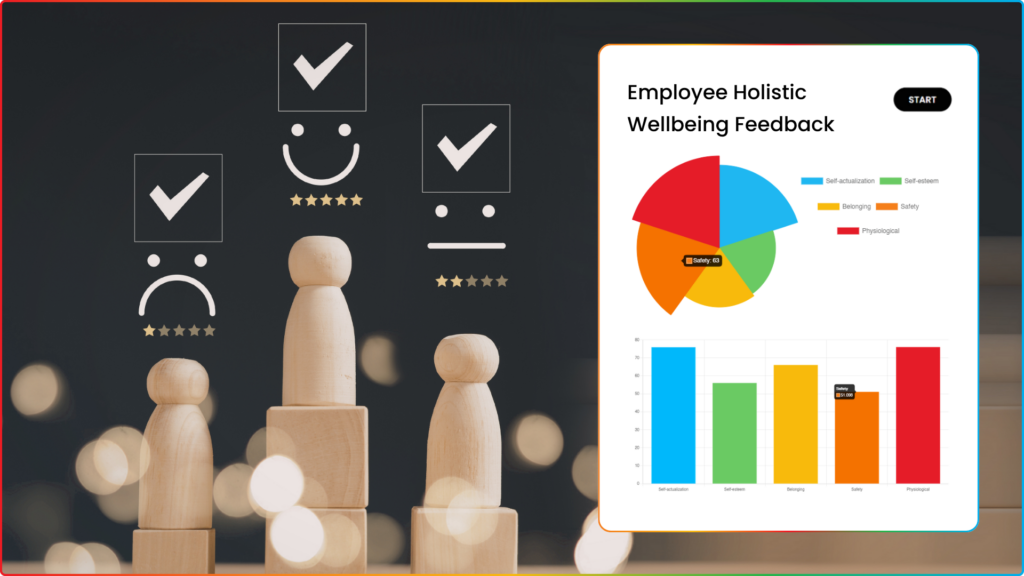

Understanding How Your People Are Doing — as a Leading Indicator of Performance and Stability
In many organizations, wellbeing is declared as a value, and only in a few organizations is it operationalized. And in even fewer, it is measured as a leading indicator of performance, retention, and organizational risk.
For the CHRO operating inside a CEO-led mandate around employee wellbeing, supported by a CFO and COO who expect measurable outcomes, the question is no longer whether wellbeing matters.
The question is:
Can we prove it?
- Can we demonstrate that investments in total rewards, leadership development, scheduling reform, flexible work, DEI initiatives, or manager training are moving the needle on actual workforce wellbeing?
- Can we show which populations are improving, and which are not?
- Can we identify an emerging strain before it appears in turnover, engagement scores, or operational performance?
With Pietential, the organizations can get insights into all the above questions.

Wellbeing as a Strategic Lever, Not a Sentiment Metric
Most HR organizations collect engagement data, conduct pulse survey and track utilization of benefits programs or EAPs. But what’s missing is the crucial information on wellbeing that comes with a structured, psychometrically validated platform like Pietential.
- Engagement measures perception of work.
- Benefits utilization measures consumption.
- Turnover measures the outcome.
- Wellbeing measures human capacity.
For a CHRO accountable to the C-suite, that distinction matters.
Wellbeing sits upstream of:
- Engagement
- Retention
- Performance
- Safety incidents
- Absenteeism
- Cultural resilience
Engagement can be part of the scoreboard of an organization, but the condition of the people involved is reflected by wellbeing. Pietential helps the organization operationalize such information.
A Workforce Wellbeing & Risk Intelligence Platform
Pietential is a science-backed wellbeing intelligence platform grounded in Maslow’s framework, not as a hierarchy, but as an integrated system of human drivers. It measures wellbeing through five core domains of Maslow; Physiological needs, safety, belonging, self-esteem, and self-actualization.
Leadership receives de-identified, aggregated wellbeing intelligence segmented by: Role, function, geography, tenure, facility, cohort, and more. This transforms wellbeing from an aspirational value into a measurable component of enterprise risk management.
For the CHRO Anchoring a CEO-Led Wellbeing Strategy
In organizations where wellbeing is a stated CEO priority, the CHRO often serves as the strategic integrator.
You are responsible for:
- Total rewards strategy
- Benefits design
- Culture initiatives
- Leadership development
- Organizational change
- Workforce planning
- DEI programming
Yet proving impact across these initiatives remains difficult.
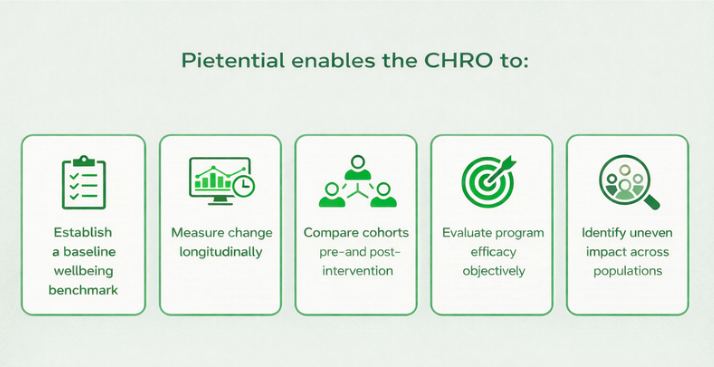
Pietential enables the CHRO to:
- Establish a baseline wellbeing benchmark
- Measure change longitudinally
- Compare cohorts pre- and post-intervention
- Evaluate program efficacy objectively
- Identify uneven impact across populations
Pietential helps you answer the powerful question;
Are we measurably strengthening workforce capacity — and reducing risk exposure?
Proving Program Efficacy
Forward-thinking CHROs are increasingly asked:
- Is our wellbeing strategy working?
- Are we improving conditions for frontline employees?
- Is hybrid work sustainable for certain roles?
- Are leadership investments strengthening psychological safety?
- Is burnout risk concentrated in specific populations?
Pietential enables structured comparison models:
- Before vs. after initiative implementation
- Program participants vs. non-participants
- Facility-to-facility benchmarking
- Department-level variance
Because the platform measures wellbeing directly, rather than proxy metrics, changes become visible in leading indicators, not just lagging ones. This allows the CHRO to enter executive discussions with objective data grounded in human drivers.
Wellbeing as Leading Enterprise Risk Intelligence
Pietential reframes wellbeing as a measurable enterprise risk variable.
Patterns such as:
- Declines in Physiological Needs among Shift Workers
- Erosion of Belonging in Remote Populations
- Drops in Self-Esteem within high-accountability roles
- Safety domain dips during restructuring
can serve as early warning signals before:
- Voluntary attrition increases
- Engagement declines
- Service errors rise
- Productivity softens
For the strategic CHRO, this becomes a bridge between human capital strategy and operational risk governance. Hence, the Wellbeing intelligence becomes a leading indicator of workforce stability.
Dual-Function: Benefit and Enterprise Risk Intelligence Tool
Pietential operates at two levels:
Employee Level (Benefit Layer)
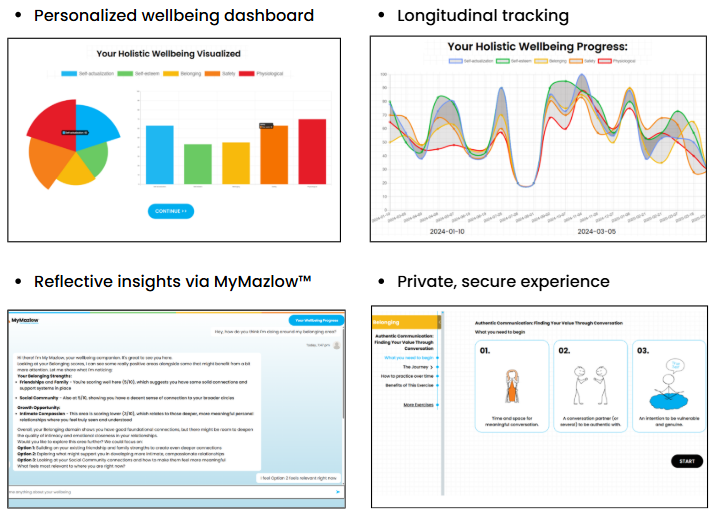
This strengthens total rewards positioning and supports individual agency.
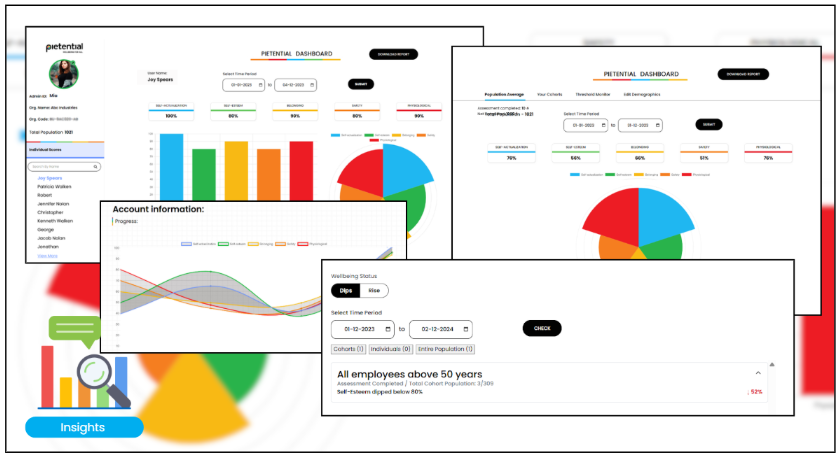
Enterprise Level (Risk Intelligence Layer)
- Aggregated, de-identified intelligence dashboard
- Cohort comparison and segmentation
- Longitudinal trend analysis
- Early risk signal detection
MyMazlow™: Reinforcing Development Without Increasing Managerial Load
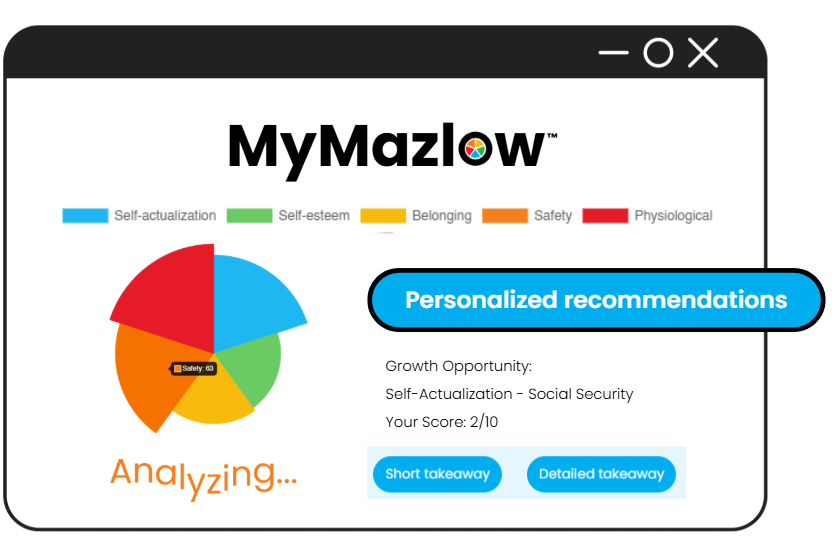
MyMazlow™, our AI Wellbeing companion, engages employees in structured reflection based on their lowest-scoring domains, making Pietential an effective Employee Engagement System.
For organizations investing in leadership training, resilience programs, or cultural transformation, this creates reinforcement between initiatives and lived experience. This ensures that development extends beyond temporary workshops into measurable longitudinal growth.
Implementation Without Operational Disruption
Deployment is straightforward:
- Invite users from Pietential’s dashboard
- Employees complete a 3–5 minute assessment
- The leadership dashboard becomes instantly available
With no heavy integration, complex system overhaul, and burden on IT, our wellbeing intelligence & risk intelligence platforms become accessible to the organization. This allows the CHRO to move from strategy to measurable intelligence quickly.
What a Strategic CHRO Gains
- A defensible baseline for workforce wellbeing
- A mechanism to prove initiative impact
- Visibility into hidden strain across roles and geographies
- Early detection of retention and stability risk
- Structured input into board-level reporting
- A shared fact base across the C-suite
Move From Cultural Intention to Measurable Risk Management
With Pietential organizations can make wellbeing a measurable metric by answering these questions.
- Are we improving it?
- For whom?
- By how much?
- And does it reduce exposure while strengthening performance?
Pietential equips the CHRO not just to advocate for wellbeing, but to demonstrate its movement, its distribution, its risk implications, and its enterprise value.