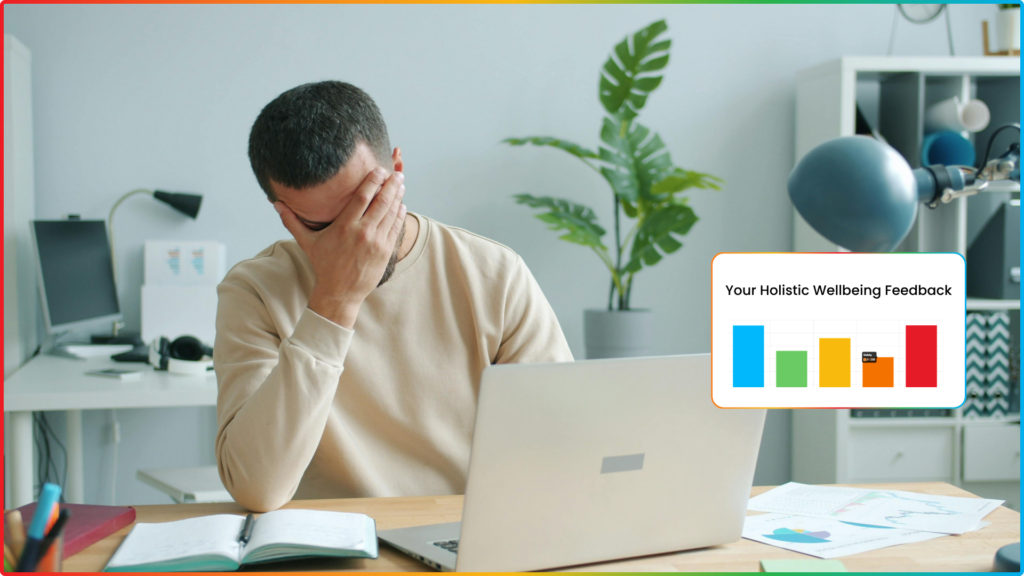

Remote and hybrid work delivered flexibility. It also removed something many leaders relied on—informal visibility.
In-office, you notice shifts: energy dips, isolation, conflict, overwork. In distributed environments, those signals are easier to miss. And when visibility is inconsistent, support becomes inconsistent too.
That creates two risks for enterprise organizations:
- Wellbeing blind spots: leaders don’t see problems until outcomes appear
- Equity gaps: different work models receive different levels of support, whether intended or not
A modern workplace wellbeing strategy has to work across all work models—and it has to be measurable enough to prove that it does.
Why distributed work creates uneven wellbeing visibility
Hybrid work models fracture the employee experience in ways that don’t always show up in traditional reporting:
Different exposure to workload and boundaries
Remote employees can experience “always on” pressure and fewer natural breaks. On-site teams may experience commute strain, shift constraints, or frontline stressors. Hybrid teams can experience coordination overhead and meeting load.
Without a structured lens, leaders often interpret all of this as “engagement issues,” when the drivers are actually different.
Different access to support
Benefits may be available to everyone, but access isn’t the same as lived experience. Psychological safety, manager behavior, team norms, and workload design vary—and distributed work makes those variances harder to detect.
Different willingness to speak up
Some employees will never raise concerns in a remote setting. Others may fear being labeled “less committed.” If your strategy depends on self-reporting or manager observation alone, you will miss entire segments.
What equitable wellbeing support requires
Equity in workplace wellbeing isn’t achieved by offering the same program to everyone. It’s achieved by ensuring:
- visibility is consistent
- needs are understood by cohort
- interventions are targeted
- impact is measurable
That is an intelligence problem, not a perks problem.
How wellbeing intelligence supports hybrid work strategy
For people analytics and HR leaders, the practical question is:
Can we compare wellbeing across remote, hybrid, and on-site teams in a way that is credible, repeatable, and actionable?
Wellbeing intelligence helps by enabling:
1) Cohort comparisons that match operating reality
Compare by work model, then layer in function, location, role type, and manager group. The objective is to isolate where work design creates strain—and where support is landing.
2) Pattern detection over time
Distributed work problems rarely appear overnight. They form gradually: reduced belonging, persistent stress, erosion of safety, declining self-esteem. Trend visibility helps leaders act early, not after attrition.
3) Targeted interventions instead of broad programs
When you know which cohorts are struggling and why, you can respond with precision: workload redesign, manager enablement, benefits alignment, or team-level norms—rather than launching another generic wellbeing initiative.
A practical starting point for leaders
If you’re trying to strengthen employee wellbeing across work models without adding complexity, start here:
- Define your cohorts (remote, hybrid, on-site) and make them visible in reporting
- Identify two or three priority outcomes leadership cares about (retention risk, performance volatility, absence)
- Track leading wellbeing signals by cohort over time
- Review on a cadence that matches decision-making (not just annual planning)
- Measure impact after interventions, not just participation
This is how wellbeing becomes operational—part of how leaders run the business, not a parallel track.
Where Pietential fits
Pietential provides a wellbeing intelligence layer—rooted in Maslow’s hierarchy of needs—that helps organizations measure wellbeing across cohorts (including remote, hybrid, and on-site), surface patterns, and track change over time.
It’s not a replacement for EAPs, surveys, or benefits platforms. It helps leaders determine whether those existing investments are improving wellbeing equitably across work models—and where targeted action is needed.