
The Question Beneath the Coaching Conversation
Every serious business coach eventually reaches a deeper question with the client: How are you objectively and conclusively measuring wellbeing, correlating it to organizational KPIs, and extrapolating that to business growth and financial outcomes? That question matters because most organizations already measure the business.
- They measure revenue.
- They measure margin.
- They measure retention.
- They measure productivity.
- They measure engagement.
- They measure customer experience.
- They measure financial performance.
- They measure growth.
But they often do not objectively measure the human wellbeing conditions that may be shaping those outcomes. They may know what happened in the business. They may not know what is happening underneath it.
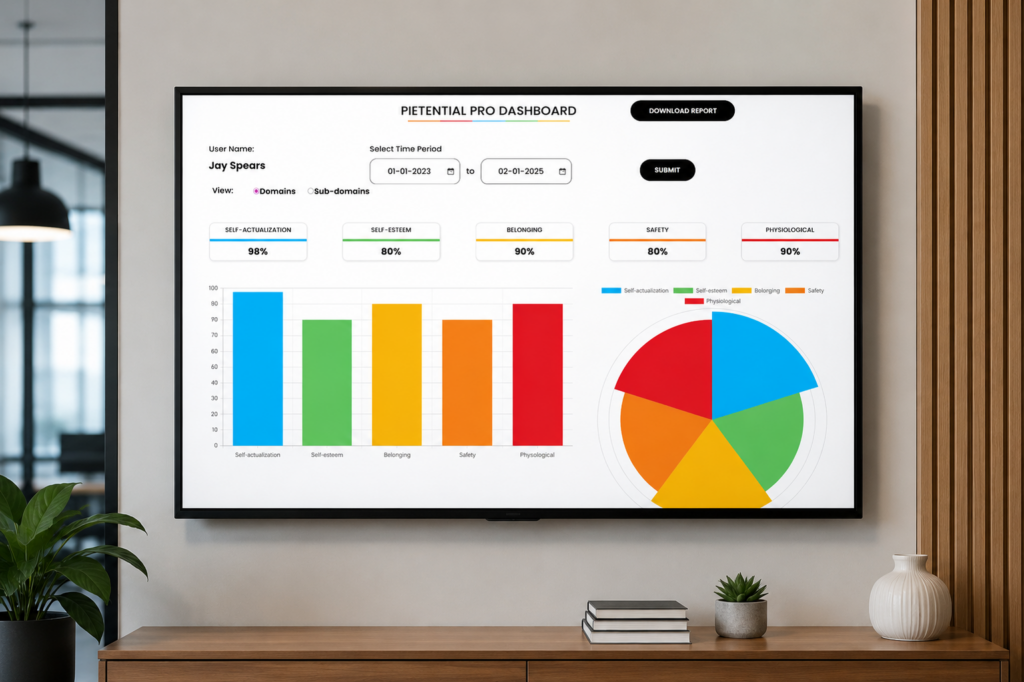
That is where the coaching conversation can become more powerful — not by replacing business judgment, and not by turning coaching into therapy, but by adding an independent wellbeing intelligence layer that helps coach and client see what may be affecting the outcomes they are already trying to improve. Pietential was built to help answer that question. It gives individuals a private, structured wellbeing journey across five dimensions and twenty subdomains.
It gives leaders an anonymized executive and leadership dashboard that shows wellbeing patterns across teams, cohorts, departments, locations, and populations. And through Transcend, Pietential’s intelligence layer, it helps correlate wellbeing patterns to organizational KPIs and extrapolate those patterns into business growth and financial outcomes. The point is not to collect wellbeing data for its own sake.
The point is to help leaders and coaches answer better business questions:
- Where is wellbeing supporting performance?
- Where is wellbeing constraining performance?
- Which teams or cohorts may be carrying hidden risk?
- How are wellbeing patterns related to engagement, productivity, retention, leadership effectiveness, customer experience, business growth, and financial outcomes?
- What should the client pay attention to before the numbers force the issue?
That is the missing layer in business coaching.


In Short
Most business coaching methodologies are built to examine strategy, behavior, accountability, leadership, execution, and results. Most coaching tools help clients understand preferences, traits, tendencies, goals, habits, values, performance patterns, or self-perception. Those tools are useful, and many coaches use them well.
What they are not designed to do is objectively and conclusively measure holistic wellbeing, establish a documented wellbeing baseline, monitor wellbeing trajectory over time, correlate wellbeing patterns to organizational KPIs, and extrapolate those correlations to business growth and financial outcomes. That is the layer Pietential adds. Pietential helps make visible the human wellbeing conditions underneath business performance — without turning the coach into a clinician or the engagement into a wellness program.
It is not therapy. It is not a wellness app. It is not a personality profile.
It is not another coaching methodology. It is independent wellbeing intelligence: a measurement layer a coach can use alongside the relationship, judgment, and business expertise they already bring.
Why This Matters Now
Business coaching has matured. Clients are more sophisticated. Organizations are more data-driven. Founders, owners, executives, boards, investors, and leadership teams increasingly want to understand not just what a coach does, but what is changing. At the same time, the coaching market is crowded with tools.
- Personality assessments.
- Strengths tools.
- Values exercises.
- Behavioral profiling systems.
- Reflective coaching exercises.
- Goal-setting frameworks.
- Leadership assessments.
- Accountability systems.
- Business diagnostics.
- KPI dashboards.
Each has a place. But none of them fully answers the central question: How are you objectively and conclusively measuring wellbeing, correlating it to organizational KPIs, and extrapolating that to business growth and financial outcomes?
Credentials tell a client a coach is qualified. A methodology tells the client how the coach works. A business diagnostic may show what is happening inside the company.
A personality or strengths profile may reveal style, tendencies, or preferences. An engagement survey may show sentiment or workplace experience. But an independent wellbeing baseline tells coach and client something different:
What is the human wellbeing underneath the work right now — in the leader, in the team, and across the organization? That matters because the visible business issue is not always the root issue. A growth stall may look like strategy.
A missed target may look like accountability. A delayed decision may look like confidence. A delegation problem may look like control.
A leadership conflict may look like communication. A retention issue may look like compensation. Sometimes those are exactly the issues.
But sometimes they are symptoms of something underneath. A founder is depleted. An owner does not feel safe enough to take the next risk.
A leadership team does not feel connected, trusted, or aligned. A high performer does not feel valued or confident enough to lead at the next level. A capable client knows what needs to happen but no longer feels connected to the purpose of the business.
A workforce is carrying strain that has not yet shown up in retention, productivity, customer experience, business growth, or financial performance. Without a structured wellbeing baseline, the coach may still sense the issue. But sensing is not the same as measuring.
That is the difference Pietential is designed to create.
The Life Balance Sheet Behind the Company Balance Sheet
“Before founding Pietential in 2020, I spent more than 20 years working with business owners, founders, and leadership teams. One truth showed up again and again: what is happening in the lives of the people running the business eventually shows up in the numbers. I think of it as the life balance sheet behind the company balance sheet.”
— John Starling, Founder & CEO, Pietential
Business performance is never only financial. The numbers matter. Revenue, margin, cash flow, retention, productivity, growth, customer experience, enterprise value, and profitability all matter. But those numbers are produced by people.
- People under pressure.
- People making decisions.
- People managing risk.
- People hiring, firing, selling, leading, negotiating, communicating, recovering, and trying to sustain momentum.
When the wellbeing of the owner, founder, executive, or leadership team is strained, it may eventually show up somewhere in the business. And when wellbeing is strained across the wider workforce, it can shape engagement, execution, productivity, customer experience, retention, business growth, and financial performance long before it reaches a report. Not always immediately.
Not always obviously. Not always in a straight line. But eventually, human capacity and business performance meet.
Pietential gives coaches and clients a way to measure that human capacity more clearly — at the level of the individual leader, across the organization, and over time — and to begin connecting wellbeing patterns to the business indicators that matter most.
The Five-Domain Capacity Map
Wellbeing is not one number. Pietential measures holistic wellbeing across five domains grounded in Maslow’s Hierarchy of Needs and modernized into a non-hierarchical model. Not a pyramid to climb.
A whole-person profile to understand. The five dimensions are:
Physiological
This is the foundation of energy, recovery, and physical capacity. When Physiological wellbeing is constrained, people may be depleted. They may have reduced energy, poor recovery, chronic stress, disrupted sleep, or diminished capacity. In a business context, this can look like inconsistent execution, slower decision-making, poor follow-through, irritability, missed details, or reduced endurance.
What appears to be a discipline problem may actually be a capacity problem.
Safety
This is the experience of stability, security, predictability, and confidence in one’s environment and circumstances. When Safety is constrained, people may not feel secure enough to take risks, speak honestly, make bold decisions, commit to change, or tolerate uncertainty. In a business context, this can look like delayed decisions, risk avoidance, over-control, information hoarding, lack of candor, or unwillingness to make a strategic bet.
What appears to be hesitation may actually be a need for stability.
Belonging
This is the experience of connection, trust, support, and being seen. When Belonging is constrained, people may feel isolated, unsupported, excluded, or disconnected from others. In a business context, this can look like leadership isolation, team friction, weak collaboration, poor communication, lack of trust, low morale, or disengagement.
What appears to be a communication problem may actually be a disconnection problem.
Self-Esteem
This is the experience of confidence, agency, self-worth, and belief in one’s ability to affect outcomes. When Self-Esteem is constrained, people may not feel capable, valued, credible, or ready to lead at the next level. In a business context, this can look like underpricing, avoidance of hard conversations, reluctance to lead, difficulty making decisions, overdependence on validation, or failure to claim authority.
What appears to be a leadership problem may actually be a confidence, agency, or identity problem.
Self-Actualization
This is the experience of purpose, growth, meaning, creativity, possibility, and movement toward potential. When Self-Actualization is constrained, people may feel disconnected from meaning, possibility, growth, or purpose. In a business context, this can look like founder fatigue, lack of innovation, loss of vision, strategic drift, disengagement from the future, or a business that is growing in a direction the leader no longer feels connected to.
What appears to be a strategy problem may actually be a purpose problem. Together, these five dimensions and twenty subdomains help coach and client see where human capacity may be supporting performance, where it may be constrained, and where the next coaching conversation may need to begin. This is the difference between a wellness score and wellbeing intelligence.
A single score may tell you something is off. A domain-level baseline helps show where. A longitudinal system helps show whether it is changing.
And when wellbeing data is examined alongside business indicators, coaches and clients can begin to understand how wellbeing may be related to execution, decision-making, retention, productivity, performance, growth, and financial outcomes.
Why Current Coaching Tools Miss This Layer
Business coaches already use useful tools. The issue is not that those tools are wrong. The issue is that they answer different questions.
Personality and Behavioral Style Tools
+Personality and behavioral style tools, such as DISC and similar assessments, can help clients understand communication style, interpersonal tendencies, and behavioral preferences. Those insights can be useful. But style is not state.
A client’s communication style may be relatively stable. Their wellbeing state may change dramatically across a quarter, a year, or a major business transition. Pietential measures current wellbeing state and tracks how that state changes over time.
Strengths, Values, and Motivation Tools
+Strengths, values, and motivation tools can help clients understand what energizes them, what matters to them, what they value, and how they prefer to operate. Examples may include strengths assessments, values exercises, Core Values-style tools, purpose exercises, or motivation frameworks. Those tools can open important conversations.
But strengths and values do not establish a documented wellbeing baseline. A client can know their strengths and still be depleted. They can know their values and still feel unsafe, disconnected, or unable to act.
Pietential helps reveal whether the client’s wellbeing is supporting or constraining their ability to use those strengths and values.
Performance and Behavioral Profiling Tools
+Performance and behavioral profiling tools, such as Taylor Protocol and similar frameworks, can help identify tendencies, motivators, patterns, and potential performance levers. Those tools can be useful for understanding how a client may operate under certain conditions. But they are not designed to measure holistic wellbeing across multiple dimensions of human need.
Pietential adds the wellbeing layer: physiological capacity, safety, belonging, self-esteem, and self-actualization.
Reflective Coaching Tools
+Reflective coaching tools, such as the Wheel of Life and similar exercises, help clients think across different areas of life. That kind of reflection can open a valuable conversation. But it is typically informal, subjective, and not psychometrically validated.
It does not provide an independent, documented wellbeing baseline or a consistent measurement system for monitoring change over time. Pietential takes the whole-life intuition behind reflective tools and gives it a validated, structured, longitudinal measurement layer.
Goal-Tracking and Accountability Systems
+Goal-tracking and accountability systems tell coach and client what happened. They may show whether the client completed commitments, hit milestones, or advanced against a plan. But progress is not always capacity.
A client may hit milestones while quietly burning down their reserves. Another may miss goals not because the strategy is wrong, but because their wellbeing conditions are undermining clarity, resilience, or follow-through. Wellbeing measurement helps reveal what may be affecting the client’s ability to make progress happen.
Business Diagnostics and KPI Dashboards
+Business diagnostics and KPI dashboards show what is happening in the business. They may show revenue pressure, margin compression, execution gaps, churn, missed targets, operational bottlenecks, or growth opportunities. But they do not show the wellbeing conditions behind the people producing those outcomes.
Pietential helps connect the human signal to the business signal.
How Pietential Answers the Core Question
The central question is not abstract: How are you objectively and conclusively measuring wellbeing, correlating it to organizational KPIs, and extrapolating that to business growth and financial outcomes? Pietential answers that question through three connected layers:
- The individual user journey
- The executive and leadership dashboard
- Transcend, Pietential’s intelligence layer
Together, these layers turn wellbeing from something a leader may sense anecdotally into something a coach and client can see, discuss, monitor, and connect to business outcomes.
1. The Individual User Journey

The journey begins with the individual. A founder, executive, manager, team member, or employee completes a brief wellbeing assessment grounded in five dimensions of human need: Physiological, Safety, Belonging, Self-Esteem, and Self-Actualization. The individual receives a private wellbeing profile that helps them see where they may be strong, strained, or changing over time.
This matters because most people do not experience wellbeing as a business metric. They experience it as energy or depletion. Safety or uncertainty.
Connection or isolation. Confidence or hesitation. Purpose or disconnection.
The user journey helps translate those lived experiences into a structured wellbeing profile that can support reflection, coaching, development, and better conversations. For the individual leader, this creates a clearer picture of the human conditions shaping how they lead. For the coach, when the client chooses to share it, it creates a more objective starting point for the coaching conversation.
The client is no longer only saying, “I feel stuck.” They can begin to see where the stuckness may be coming from.
2. The Executive and Leadership Dashboard

At the organizational level, Pietential aggregates wellbeing data anonymously across teams, cohorts, departments, locations, or other relevant groups. The executive and leadership dashboard helps leaders see patterns they could not responsibly see at the individual level. Where is wellbeing strongest?
Where is it slipping? Which cohorts appear to be carrying strain? Which dimensions of wellbeing are most constrained?
Where might leadership, culture, or execution be affected by unmet human needs? This is not about exposing individuals. It is about helping leaders understand the wellbeing conditions across the organization they are responsible for leading.
For a business coach, this changes the conversation with the client. The coach is no longer relying only on what the founder feels, what the leadership team reports, or what the financials show after the fact. Coach and client can examine anonymized wellbeing patterns as part of the business system.
3. Transcend: Connecting Wellbeing to KPIs, Business Growth, and Financial Outcomes

Transcend is Pietential’s intelligence layer. It is designed to help leaders connect anonymized wellbeing patterns to the business outcomes they already care about: engagement, performance, retention, productivity, leadership effectiveness, customer experience, business growth, financial risk, and downstream financial outcomes. This is where wellbeing becomes more than a profile or dashboard.
It becomes a way to ask better business questions:
- Where might low Safety be affecting risk-taking, candor, or decision speed?
- Where might low Belonging be affecting trust, collaboration, or retention?
- Where might low Physiological wellbeing be affecting execution, recovery, or productivity?
- Where might low Self-Esteem be affecting leadership confidence, ownership, or accountability?
- Where might low Self-Actualization be affecting innovation, purpose, or long-term commitment?
- Where might a wellbeing pattern be showing up in the KPIs the client already monitors?
- What business growth or financial exposure may be forming if the wellbeing condition is ignored?
Transcend does not reduce business performance to wellbeing alone. Business outcomes are shaped by many factors: strategy, market conditions, capital, operations, leadership, product quality, sales execution, customer behavior, and more. But wellbeing is one of the human conditions that can influence decision-making, execution, resilience, communication, leadership, retention, productivity, and performance.
Transcend helps make that condition measurable and connectable, so it can be examined alongside the KPIs, business growth indicators, and financial outcomes the client already cares about. For the coach, this creates a more strategic conversation. For the client, it creates a clearer line of sight between human capacity and business performance.
The Questions This Helps Companies Answer
Together, the user journey, executive dashboard, and Transcend help companies ask questions most organizations struggle to answer clearly:
- Are our people well enough to execute the strategy we are asking them to carry?
- Where is wellbeing supporting performance?
- Where is it constraining performance?
- Are leaders making decisions from clarity, confidence, and capacity — or from depletion, fear, isolation, or disconnection?
- Which teams or cohorts may be carrying hidden risk before it shows up in turnover, productivity, customer experience, business growth, or financial performance?
- Are our wellbeing conditions improving, declining, or staying flat over time?
- How do changes in wellbeing correlate to the KPIs and business outcomes we already monitor?
- How might those correlations extrapolate into business growth and downstream financial outcomes?
- What should we pay attention to before the numbers force the issue?
That is the practical value of independent wellbeing intelligence. It gives coaches and clients a way to see the human layer of business performance before it becomes visible only as a business problem.
Two Views of the Same Client
Pietential gives coaches two connected views of the same client. Used together, they let the coach work with an objective wellbeing layer beneath the insight they already bring.
The Individual View: For the Leaders You Coach Directly
Each founder, owner, executive, or leadership team member receives their own private holistic wellbeing report across all five dimensions and twenty subdomains. This gives coach and client a shared, objective picture of the human conditions shaping how the leader leads: clarity, resilience, focus, confidence, communication, risk tolerance, and follow-through. Individual reports help surface the deeper personal drivers behind what coach and client may already be seeing in the business.
These reports are private to the individual person and are used only within the coaching relationship, on the individual’s terms.
The Organizational View: Across the Client’s Business
When it fits the engagement, Pietential can be deployed across the client organization to measure wellbeing at the team, cohort, and population level. Here, results are anonymized and cohort-level. The executive and leadership dashboard helps the client organization see where wellbeing is strong, where it is slipping, and which groups may be carrying risk.
Through Transcend, Pietential connects those organizational wellbeing patterns to the outcomes leaders care about: engagement, performance, retention, productivity, leadership effectiveness, customer experience, business growth, financial risk, and downstream business outcomes. This gives the client organization a clearer view of what may be forming beneath the numbers before it reaches the dashboard.
The Boundary
The two views stay separate by design. Individual results stay private to the person. Organizational insight stays anonymous and cohort-level.
Transcend interprets organizational and cohort-level patterns. It does not expose individual people’s wellbeing reports to the client organization, employer, or leadership. This boundary is what makes it possible to work at both levels responsibly. The coach can support the individual leader with private insight and support the organization with anonymized intelligence.
Use Case: When a Strategic Stall Is Really a Safety Constraint
The scenario below is illustrative and composite. It does not describe an actual Pietential client. A business coach is working with the owner of a 35-person marketing agency. The company has revenue opportunity, a strong reputation, and a clear path to expand into a new service line.
The owner understands the opportunity and has the authority to move. But the decision keeps getting deferred.
Without a Wellbeing Baseline
+The coach might reasonably read the stall as a confidence, risk-tolerance, or decision-making issue. The conversation may focus on strategic clarity, decision frameworks, accountability, courage, or encouragement. Those may all be relevant.
But if the underlying constraint is not visible, the coaching plan may keep circling the wrong layer.
With the Individual Wellbeing Baseline
+An independent, domain-level read shows the owner is not low in Self-Esteem. They are low in Safety. A follow-up conversation reveals that the owner is still carrying unresolved financial instability from the prior year.
The new service line is strategically sound. But emotionally and financially, it feels unsafe. The coaching plan shifts.
The work is no longer simply: “Be bolder.” It becomes:
“What stability needs to exist for this risk to become executable?” The strategy did not change. The starting point changed.
With the Organizational View
+Deployed across the agency, anonymized cohort data shows something the owner had not connected to the stall. Safety and Belonging are also low across the senior team. Transcend flags an early correlation with rising retention risk in that group.
The picture sharpens. The owner’s hesitation is not only personal. The team the expansion would depend on is itself under strain.
The coaching plan now addresses both: the owner’s own Safety and the conditions across the senior team that the new service line would rely on. The coach and client can now ask better questions: Is the team stable enough to absorb this expansion?
Where is trust strong enough to carry the change? Where might retention risk compromise execution? What operational or leadership moves would improve the conditions required for the strategy to succeed?
What business growth or financial exposure could result if the expansion depends on a team already carrying unresolved strain? The strategy did not change. What changed was knowing where to start, how far the pattern reached, and what business risk may be forming if the wellbeing condition is ignored.
How Coaches Can Use This Without Becoming Clinicians
Pietential is a wellbeing measurement system, not a clinical tool. That distinction matters. The coach does not diagnose.
The coach does not treat. The coach does not become a therapist. The coach does not reduce business performance to someone’s wellbeing score.
Instead, the coach uses the wellbeing data as structured context. The data helps coach and client ask better questions:
- What does this profile help us see?
- What feels accurate?
- What surprises you?
- Which wellbeing dimensions appear to be supporting your leadership?
- Which dimensions may be constraining your leadership?
- Where might this be showing up in the business?
- What should we pay attention to over the next 30, 60, or 90 days?
- What would need to change for the business goal to become more executable?
This is not clinical interpretation. It is evidence-informed coaching. The coach remains the coach.
The business remains the business. Pietential helps make the wellbeing layer visible.
The Business Case for Seeing More
The strongest business coaches already bring insight, judgment, frameworks, accountability, and trust. Pietential gives that work a firmer measurement layer.
Client Value
+Clients do not only need a plan. They need to understand whether they, their leadership team, and their organization currently have the wellbeing capacity to execute it. Pietential helps clients see how wellbeing may be supporting or constraining their goals.
It helps them see what may be underneath stalls, plateaus, execution gaps, leadership strain, retention risk, productivity issues, business growth constraints, and financial exposure.
Better Decision-Making
+When wellbeing conditions are visible, leaders can make better-informed decisions. They can see whether a business problem may also be a capacity problem. They can see whether a team is ready to absorb change.
They can see whether a strategy depends on people who are already depleted, disconnected, or unsafe. They can see whether the human conditions required for execution are strengthening or weakening over time.
Stronger Coaching Conversations
+When coach and client can return to an objective wellbeing baseline, the conversation becomes more grounded. Progress reviews are no longer based only on memory, narrative, or interpretation. Coach and client can examine what has changed, what has not changed, and where attention may be needed next.
Stakeholder Credibility
+When coaching is sponsored, funded, or watched by an employer, investor, board, or leadership team, documented wellbeing measurement can support a more credible conversation about what is changing. The coach still owns the coaching relationship. Pietential provides a clearer input.
Business Outcome Visibility
+Over time, wellbeing data can be examined alongside business indicators such as revenue growth, retention, productivity, leadership effectiveness, execution consistency, customer experience, and financial performance. At the organizational level, Transcend makes this connection directly by correlating anonymized wellbeing patterns to organizational KPIs and extrapolating those correlations into business growth and downstream financial outcomes.
The point is not to reduce business success to wellbeing alone. The point is to stop treating wellbeing as invisible when it may be shaping the numbers.
Coach Differentiation
+The coach’s differentiation follows from the client value. In a crowded market, coaches who can bring an independent, validated wellbeing intelligence layer into the engagement offer something meaningfully different. Not another methodology.
Not another personality tool. Not another reflection exercise. A way to help the client see the human conditions underneath business performance.
What an Independent Baseline Actually Is
The wellbeing category is crowded with tools that sound similar but do very different things. Pietential is different. It is not a wellness app. It does not prescribe meditation minutes, track steps, or recommend generic content.
It is not an EAP. It does not provide therapy, counseling, or crisis support. It is not a personality test. It does not measure style, type, or trait preference. It is not an engagement survey. It does not merely measure organizational climate, manager sentiment, or employee engagement scores.
It is not a business diagnostic. It does not replace financial, operational, or strategic analysis. Pietential is an independent, psychometrically validated measurement of holistic wellbeing across five dimensions and twenty subdomains, tracked over time, at the individual and organizational level. It creates an objective, documented baseline that coach and client can use alongside the coaching relationship that already exists.
What Pietential Is, and Is Not
Pietential Is
- An Independent Wellbeing Intelligence System
- A psychometrically validated wellbeing assessment
- A five-domain, twenty-subdomain model of holistic wellbeing
- A way to establish an objective, documented wellbeing baseline
- A longitudinal measurement system for monitoring wellbeing over time
- A private user journey for individual wellbeing insight
- An anonymized executive and leadership dashboard for organizational wellbeing patterns
- Transcend, an intelligence layer that correlates wellbeing patterns to organizational KPIs and extrapolates those correlations to business growth and financial outcomes
- A client-facing visualization tool
- A measurement layer that supports coaching conversations at both the individual and organizational level
Pietential Is Not
- A coaching methodology
- A personality test
- A wellness app
- An EAP
- Therapy
- Medical advice
- Mental health treatment
- A diagnostic tool
- A replacement for business judgment
- A replacement for the coach
The coach remains the coach. The business remains the business. Pietential helps make the wellbeing layer visible.
Frequently Asked Questions
Does this replace what I already do as a coach?
No. Pietential does not coach and does not deliver interventions. It measures wellbeing.
The coaching, judgment, relationship, plan, accountability, and business expertise stay with you. Pietential adds an objective wellbeing input to work with.
Is this the same as DISC, StrengthsFinder, Taylor Protocol, Wheel of Life, or similar tools?
No. Those tools can be useful, but they measure different things: personality, style, preferences, strengths, values, performance tendencies, or self-reflection. Pietential measures current holistic wellbeing across five dimensions and twenty subdomains, establishes an objective baseline, and monitors change over time.
Style is not state. Reflection is not measurement. Pietential measures wellbeing state.
How does Pietential connect wellbeing to business outcomes?
At the organizational level, Transcend, Pietential’s intelligence layer, reads anonymized wellbeing patterns across the workforce and connects them to outcomes leaders care about: engagement, performance, retention, productivity, leadership effectiveness, customer experience, business growth, financial risk, and downstream financial outcomes. It surfaces where wellbeing conditions may be shaping those outcomes early, while there is still time to act.
These are evidence-informed signals designed to improve the conversation, not replace the coach’s judgment or the client’s business judgment.
Does Transcend analyze individual people’s wellbeing data?
No. Transcend interprets anonymized organizational and cohort-level patterns. It does not expose any individual person’s wellbeing report to the client organization, employer, or leadership.
Individual insight comes from the person’s own private report, used within the coaching relationship if that person chooses to share it. Organizational insight stays anonymous. Individual clarity stays private.
Can my client organization see individual people’s results?
No. Individual wellbeing reports are private to each person. They are shared only within the coaching relationship, on the individual’s terms.
Organizational views are anonymized and cohort-level.
Do I need to be a clinician to use this with clients?
No. Pietential is an independent wellbeing measurement system, not a diagnostic or clinical tool. It is not intended to replace medical or mental health care.
Can I use this with an individual client whose employer is not involved?
Yes. Independent practitioners and their individual clients can use Pietential directly, outside of any organizational or employer context. The organizational view and Transcend simply are not used in that case.
The individual wellbeing report stands on its own.
How is this different from an employee engagement survey?
Engagement surveys typically measure organizational climate, employee sentiment, or manager-related experience in aggregate. Pietential measures holistic wellbeing across five dimensions. Where appropriate and consented, that wellbeing data can also be aggregated anonymously to understand broader patterns across teams and cohorts.
Transcend then connects those patterns to organizational KPIs, business growth, and financial outcomes.
Can wellbeing really be connected to business outcomes?
Yes, but responsibly. Pietential does not claim that wellbeing alone explains business performance. Business outcomes are shaped by many factors: strategy, market conditions, capital, operations, leadership, product quality, sales execution, customer behavior, and more.
But wellbeing is one of the human conditions that can influence decision-making, execution, resilience, communication, leadership, retention, productivity, and performance. Pietential helps make that condition measurable, so it can be examined alongside the KPIs, business growth indicators, and financial outcomes the client already cares about.
Next Step
See what an objective wellbeing baseline could add to your practice. We are inviting a small group of business coaches into private partner conversations about how independent wellbeing measurement can fit alongside coaching practice. No cost.
No obligation. No pitch deck required. Just a focused conversation about whether this measurement layer could help you and your clients see more clearly — in the leaders you coach and across the organizations they run.
Book a Private Session →Sources and Further Reading
This guide may draw on research and reporting from: International Coaching Federation. (2025). 2025 ICF Global Coaching Study. International Coaching Federation. Gallup. (2025). State of the Global Workplace: 2025 Report. Gallup.
Arnsten, A. F. T. (2009). Stress signalling pathways that impair prefrontal cortex structure and function. Nature Reviews Neuroscience, 10(6), 410–422. McEwen, B. S. (1998). Stress, adaptation, and disease: Allostasis and allostatic load. Annals of the New York Academy of Sciences, 840(1), 33–44. Freeman, M. A., Staudenmaier, P. J., Zisser, M. R., & Andresen, L. A. (2019). The prevalence and co-occurrence of psychiatric conditions among entrepreneurs and their families. Small Business Economics, 53(2), 323–342.
Cooper, C. L., & Dewe, P. J. (2008). Well-being, absenteeism, presenteeism, costs and challenges. Occupational Medicine, 58(8), 522–524. World Health Organization. (2019). Burn-out an occupational phenomenon: International Classification of Diseases. Podsakoff, P. M., MacKenzie, S. B., Lee, J. Y., & Podsakoff, N. P. (2003). Common method biases in behavioral research: A critical review of the literature and recommended remedies. Journal of Applied Psychology, 88(5), 879–903.
Maslow, A. H. (1943). A theory of human motivation. Psychological Review, 50(4), 370–396.
Disclaimer
This guide is intended as general educational information for coaching practitioners and does not constitute clinical, medical, or mental health advice. Pietential is an independent wellbeing measurement platform and does not provide therapy, counseling, clinical diagnosis, or medical care.