
Many organizations can showcase an impressive lineup of wellbeing tools:
- meditation platforms
- resilience workshops
- mental health benefits
- wellbeing days
- fitness challenges
- manager training
But fewer can confidently answer a more difficult question:
Is any of this actually improving workplace wellbeing?
Activity is easy to track. Impact is harder—unless you deliberately look for it.
The illusion of progress
Wellbeing programs create visible effort. Launches are announced. Usage dashboards are shared. Leaders highlight participation milestones.
But without outcome measurement, organizations risk managing perception rather than progress.
If you cannot see:
- where support is landing—or missing
- how different groups are experiencing wellbeing
- whether burnout risk is declining in critical roles
- which investments are closing equity gaps
…you are operating on assumption.
Why impact often goes unmeasured
Three patterns commonly explain the gap:
1) Fragmented data across vendors
EAPs, benefits providers, engagement tools, and learning platforms all generate data—often in isolation. Aggregating usage is possible. Measuring holistic wellbeing change across the system is not.
2) Metrics focused on utilization, not outcomes
Vendors frequently report adoption and satisfaction. Few can demonstrate change in employee wellbeing across cohorts over time.
3) No baseline or longitudinal tracking
Without a consistent measurement framework, it becomes difficult to answer: “Did this improve conditions?”
This leaves leadership conversations stuck at surface level.
The shift from availability to accountability
A mature workplace wellbeing strategy asks different questions:
- Which teams show sustained improvement in safety, belonging, and esteem?
- Where is stress persisting despite available support?
- Are certain demographics experiencing different trajectories?
- Did our intervention reduce risk in the intended cohort?
This is the distinction between offering support and managing impact.
Measurement vs intelligence
Measurement alone produces numbers. Intelligence connects those numbers to decisions.
When organizations implement wellbeing intelligence, they gain:
- cohort-level visibility
- trend analysis across time
- early detection of risk clusters
- evidence of improvement (or stagnation)
This enables a cycle of refinement rather than repetition.
A practical playbook for moving beyond programs
For upper mid-market and enterprise organizations:
1) Define the outcomes each program is intended to influence
Clarity prevents generic reporting.
2) Establish a consistent wellbeing measurement framework
Use a structured model that captures core dimensions of employee wellbeing.
3) Segment and trend the data
Impact is rarely uniform. Identify where programs create measurable movement.
4) Adjust based on evidence
Retire what does not move the margin. Expand what does.
Over time, wellbeing becomes a managed system—not a collection of activities.
Where Pietential fits
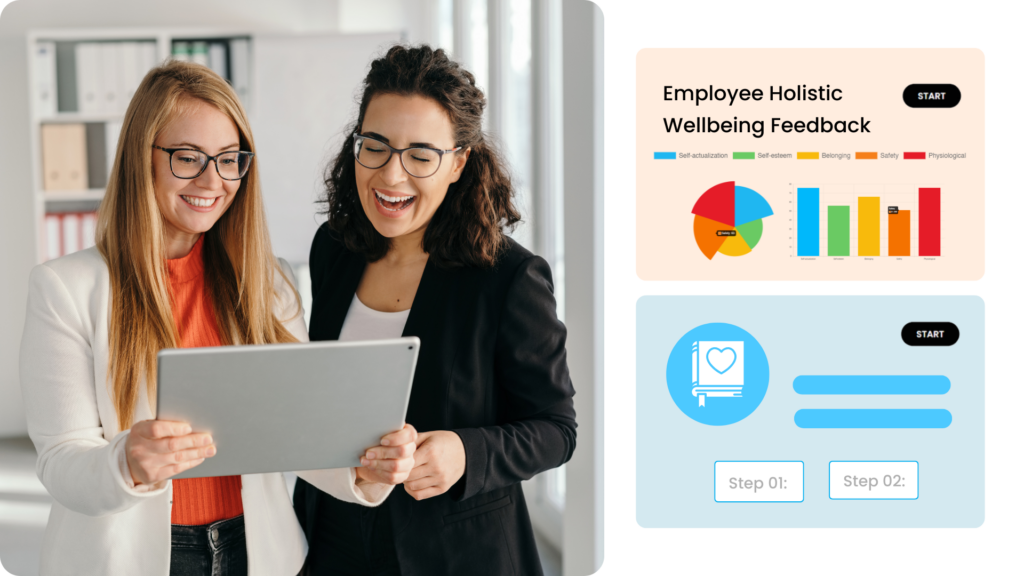
Pietential acts as a wellbeing intelligence layer rooted in Maslow’s hierarchy of needs—helping organizations measure holistic wellbeing, segment results across teams and cohorts, and track change over time.
It does not replace existing programs. It helps determine whether those programs are creating measurable improvement—and where strategic adjustments are required.