
An annual survey captures a moment.
Workforce wellbeing is not a moment.
It shifts with workload cycles, leadership transitions, organizational change, market volatility, and even seasonal pressures. Stress builds gradually. Engagement fluctuates. Psychological safety can strengthen — or erode — over months.
Yet many enterprise organizations still rely on annual or biannual engagement surveys as their primary wellbeing signal.
That gap between frequency and reality creates strategic blind spots.
The Snapshot Problem
Annual engagement surveys serve a purpose. They provide directional insight and surface broad themes.
But they are snapshots.
A snapshot cannot show:
- How stress trends evolve month to month
- Whether an intervention reduced burnout risk
- Where wellbeing is improving — or quietly declining
- Which teams are becoming fragile under pressure
Harvard Business Review has noted that many workplace wellbeing programs fail not because of lack of investment — but because organizations lack meaningful, ongoing measurement of impact.
Without time-based tracking, leaders are left interpreting static averages.
And averages conceal volatility.
Burnout Develops Over Time — Not Overnight
The World Health Organization defines burnout as a syndrome resulting from chronic workplace stress that has not been successfully managed.
“Chronic” is the key word.
Burnout accumulates.
An employee rarely moves from thriving to disengaged in a single quarter. Instead, unmet needs compound gradually — workload strain, lack of recognition, diminished belonging, psychological fatigue.
When measurement occurs only once per year, early warning signs are missed.
By the time engagement scores dip significantly, productivity has already been affected — and retention risk has likely increased.
Continuous workforce wellbeing measurement allows leaders to observe trajectory — not just outcome.
Executives Need Trendlines, Not Anecdotes
For CHROs, CFOs, and COOs, the conversation has evolved.
Leadership no longer asks:
“Are people satisfied?”
They ask:
- “Are we improving wellbeing year over year?”
- “Which initiatives are moving the margin?”
- “Where is risk forming?”
- “Can we demonstrate ROI from our wellbeing investments?”
These are longitudinal questions.
They cannot be answered with single-point-in-time data.
In enterprise environments, budget protection requires evidence of change — not just activity.
Continuous measurement transforms wellbeing from sentiment to signal.
The Link Between Continuous Data and ROI Clarity
Deloitte research highlights that organizations prioritizing employee wellbeing report measurable improvements in retention and productivity.
But proving that link internally requires consistent tracking.
If an organization launches:
- A mental health benefit
- A leadership development initiative
- A flexibility policy
- A DEI effort
How do leaders know whether it worked?
Participation metrics show adoption.
Continuous measurement shows impact.
By tracking wellbeing across defined domains over time, HR leaders can isolate whether specific initiatives correspond with measurable improvements in workforce wellbeing — and whether those improvements correlate with retention and performance outcomes.
That is the difference between spending and strategy.
Why Averages Are Misleading
Another limitation of annual surveys is aggregation.
Enterprise organizations often report organization-wide averages. But workforce wellbeing is rarely uniform.
Some teams thrive. Others struggle quietly.
Continuous measurement allows leaders to:
- Segment by department, role, or demographic group
- Identify localized stress patterns
- Detect hidden burnout pockets
- Intervene surgically rather than broadly
This level of visibility reduces overcorrection and improves resource allocation.
Instead of launching company-wide initiatives in response to generalized survey feedback, leaders can target support where it is most needed.
That precision strengthens both ROI and credibility.
From Reactive to Predictive
When measurement is infrequent, leadership becomes reactive.
Problems are addressed after they surface in:
- Exit interviews
- Productivity declines
- Absenteeism increases
- Engagement score drops
Continuous workforce wellbeing measurement introduces a predictive layer.
Small shifts — declining belonging, rising stress, reduced sense of safety — become visible early.
Early visibility enables early action.
And early action is significantly less expensive than late intervention.
What Continuous Measurement Actually Requires
Moving beyond annual surveys does not mean overwhelming employees with constant questionnaires.
It requires:
- Structured, validated frameworks
- Domain-level wellbeing assessment
- Longitudinal tracking
- Cohort analysis capability
- Executive-ready reporting
Most importantly, it requires clarity about what is being measured and why.
Wellbeing is multidimensional. Measuring it effectively means looking beyond engagement into core human needs that drive sustainable performance.
Where Pietential Fits
This is where a workforce wellbeing intelligence layer like Pietential becomes valuable.
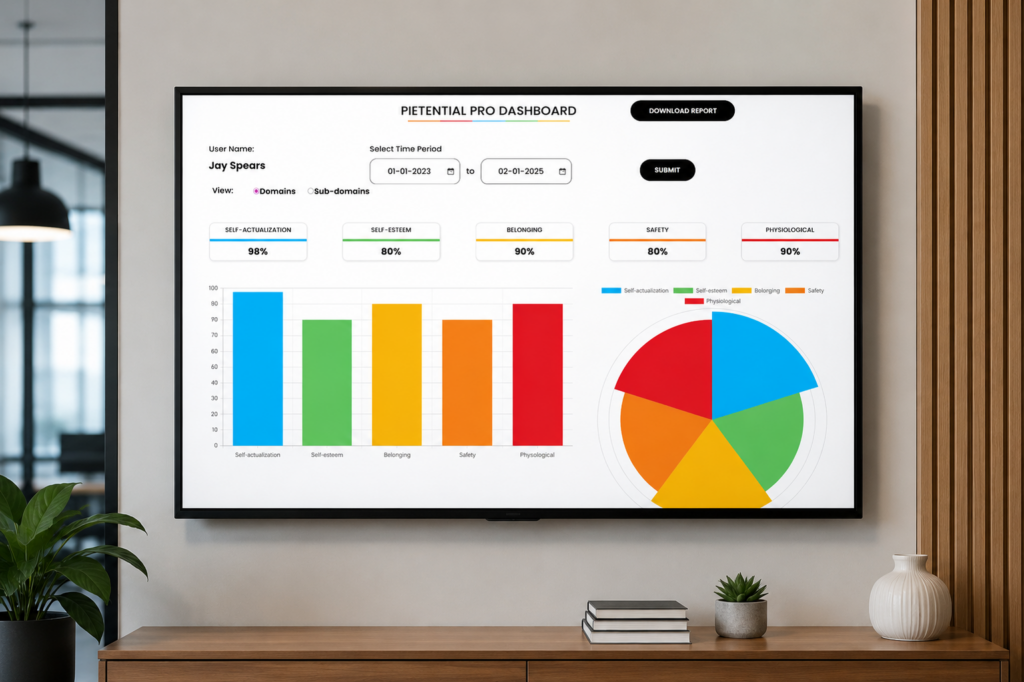
Rooted in Maslow’s Hierarchy of Needs, Pietential enables organizations to measure wellbeing across five core domains and track change over time.
For enterprise HR leaders, this supports:
- Continuous trend visibility
- Early burnout signal detection
- Clear linkage between initiatives and wellbeing shifts
- Executive-level reporting on impact
The objective is not more surveys.
It is structured, ongoing insight that allows organizations to move from snapshot to trajectory — and from reactive correction to predictive strategy.
Final Thought
Annual surveys tell you where you were.
Continuous workforce wellbeing measurement tells you where you are headed.
In a volatile workforce environment, trajectory matters more than static scores.
Organizations that measure change — not just sentiment — gain earlier warning signals, stronger ROI clarity, and greater resilience.
Sources
Harvard Business Review – Why Workplace Wellbeing Programs Fail
https://hbr.org/2019/10/why-your-wellness-program-isnt-working
World Health Organization – Burnout Definition
https://www.who.int/mental_health/evidence/burn-out/en/
Deloitte – Workplace Well-being Research
https://www2.deloitte.com/us/en/insights/topics/talent/workplace-well-being.html