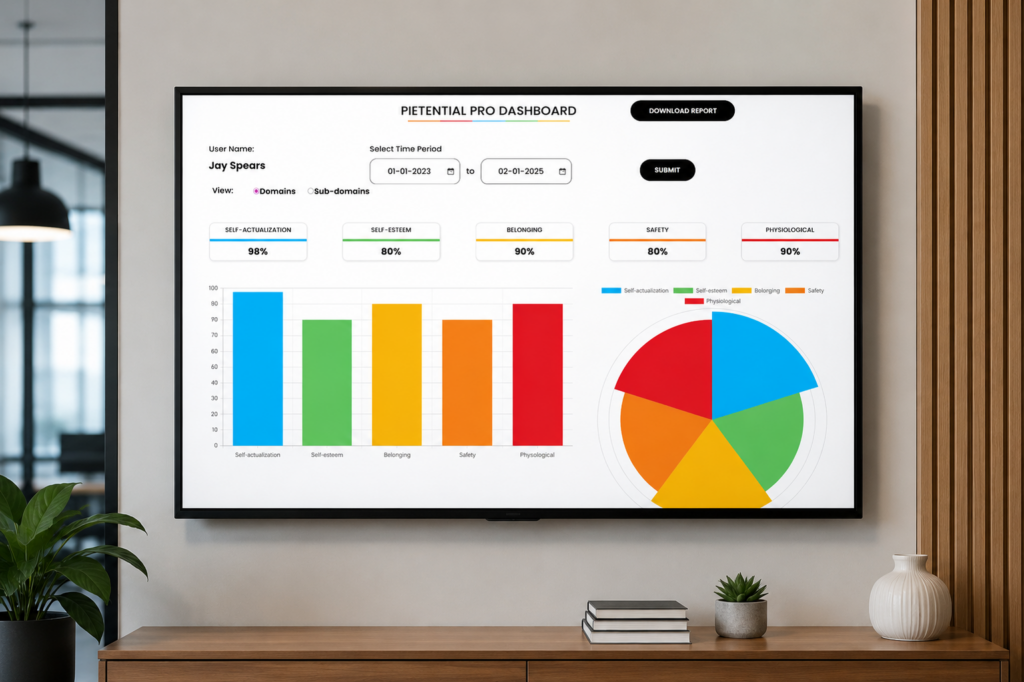

“What becomes possible when wellbeing becomes an early warning signal for workforce stability, retention risk, and operational performance?”
Making Workforce Risk Visible Before It Becomes Operational Loss
Across the U.S. economy, certain industries operate under sustained pressure.
Healthcare, Education, Technology, Finance, Hospitality, Retail, Manufacturing,
Construction, Public service, Telecommunications, Information services, and
more.
These sectors differ operationally, but they share common realities:
- Chronic workload intensity
- Emotional labor and customer-facing demands
- Staffing shortages and high turnover
- Rapid digital transformation and cognitive fatigue
- Regulatory scrutiny and performance pressure
- Distributed, hybrid, or shift-based teams

Why Now: Workforce Risk Is Increasingly Human-Centered
Post-pandemic operating environments have permanently shifted workforce
dynamics. Employees in high-burnout industries are re-evaluating sustainability,
meaning, and tradeoffs. At the same time, organizations are being asked to:
- Operate leaner
- Digitize faster
- Maintain compliance
- Preserve service quality
- Improve retention
In distributed or frontline-heavy environments, strain is often invisible until it
becomes attrition, disengagement, errors, or service degradation. But when
Wellbeing becomes the leading indicator, it helps avert performance and
retention risk exposure. Pietential operationalizes that insight.
Wellbeing as a Workforce Risk Intelligence Layer
Pietential is a workforce wellbeing intelligence platform grounded in Maslow’s
Hierarchy of Needs, not as a hierarchy, but as an integrated system of human
drivers.
It measures wellbeing across five core domains: Physiological Needs, Safety,
Belonging, Self-Esteem and Self-Actualization
How does it work?
- Each employee receives a personalized wellbeing visualization.
- Leadership receives de-identified, aggregated intelligence segmented by role, tenure, geography, facility, or function.
This creates a structured, measurable view of workforce capacity, allowing
organizations to identify risk clusters before they become operational disruptions,
making it predictive.
Designed for High-Pressure Environments
Pietential is particularly valuable in sectors such as:
- Healthcare and long-term care
- K-12 and higher education
- Technology and cybersecurity
- Finance and insurance
- Hospitality and leisure
- Retail and wholesale trade
- Manufacturing and production
- Construction and skilled trades
- Public administration and government
- Telecommunications and information services — and more
These industries share one vulnerability: sustained strain without structured
visibility. But Pietential provides that visibility.

Employee Wellbeing Journey
Personalized Wellbeing Dashboard (Employee View)
Each employee receives a private, secure dashboard that allows them to:
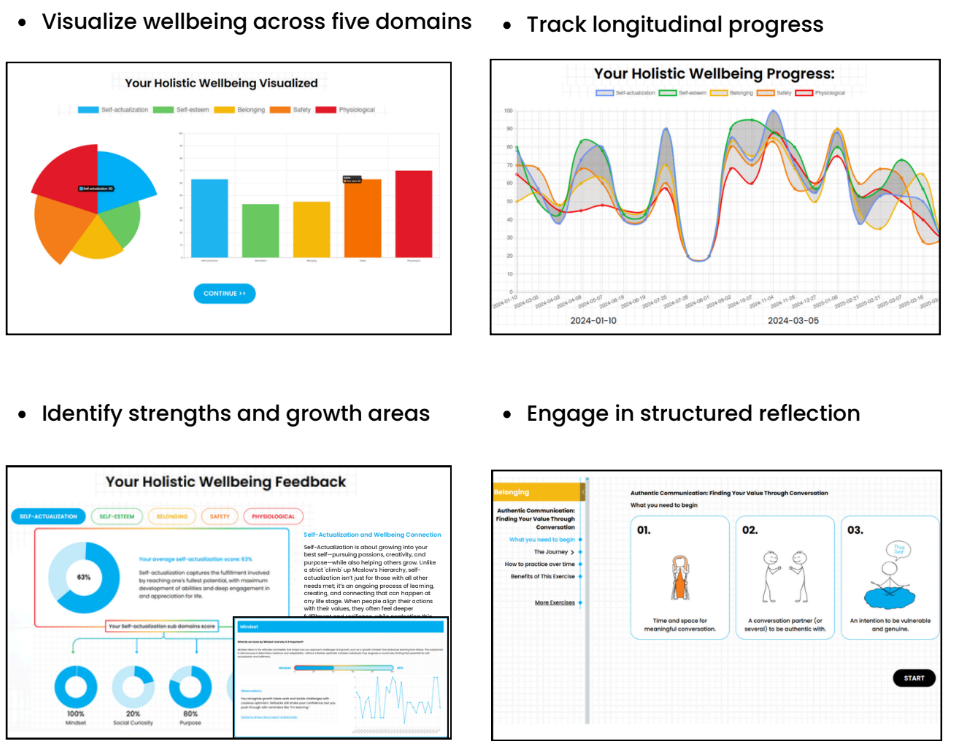
This strengthens individual agency while generating aggregated organizational intelligence.
Tools for Leaders Managing Workforce Risk.
Leaders access de-identified, aggregated wellbeing intelligence that allows them to:
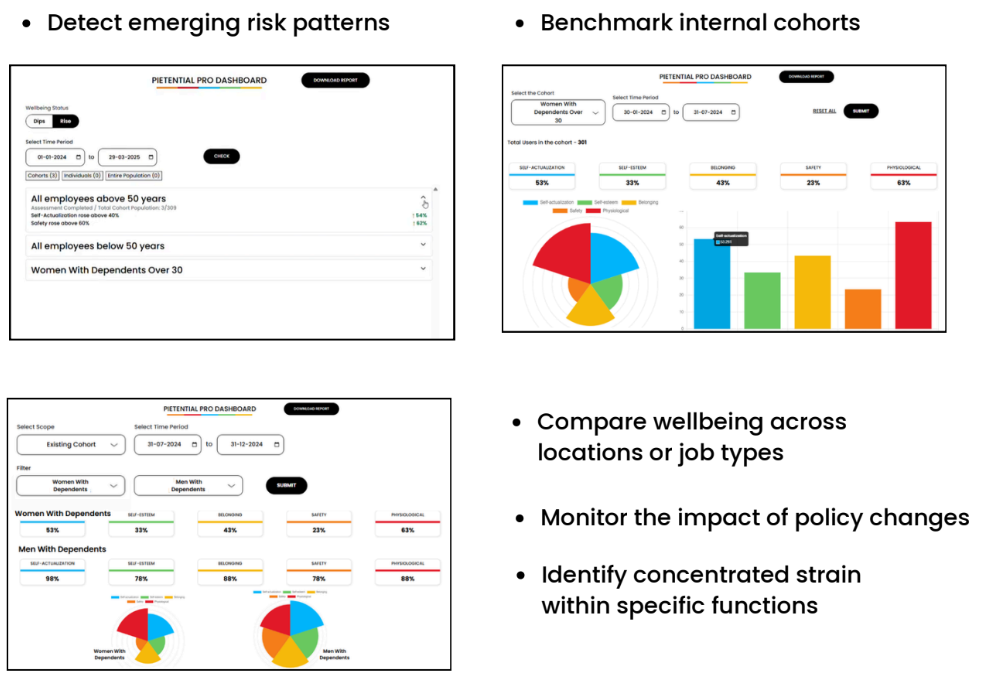
This transforms wellbeing from a cultural concept into a measurable risk input.
MyMazlow – Individualized Resilience Support
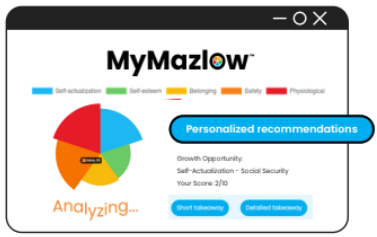
MyMazlow, our AI wellbeing companion, engages employees in reflective dialogue based on their lowest-scoring domains. In high-burnout sectors, from frontline service roles to distributed technical teams, individualized support strengthens resilience without increasing managerial load. This improves workforce stability while preserving privacy.
Wellbeing Progress Monitoring & Early Risk Signals
Organizations can:
- Monitor wellbeing trends longitudinally
- Set threshold alerts
- Identify early warning signals in specific roles or geographies
This is especially valuable during:
- Rapid expansion
- Staffing shortages
- Operational restructuring
- Digital transitions
- Regulatory change
Wellbeing intelligence becomes an early warning system.
Segmentation & Comparative Risk Analysis
Leaders can filter insights by:
- Facility or region
- Job function
- Tenure
- Employment type (remote, hybrid, frontline)
This reveals hidden risk concentrations such as:
- Fatigue clustering in shift workers
- Belonging gaps in remote teams
- Psychological safety dips during restructuring
- Self-esteem erosion in high-accountability environments
Interventions become targeted, data-informed, and measurable.
Launch in Three Simple Steps
1.Invite users from Pietential’s dashboard
2.Staff complete the 3–5 minute assessment
3.The leadership dashboard goes live instantly
With no heavy integration, complex system overhaul, and burden on IT, our
wellbeing intelligence & risk intelligence platforms become accessible to
the organization.
What Leaders Gain
Across high-burnout industries, Pietential delivers:
- Early detection of workforce strain
- Objective insight into retention risk
- Structured input into operational planning
- Evidence to evaluate internal initiatives
- A shared, neutral fact base across leadership and workforce
- representatives
- Scalable intelligence across sites and roles
It reframes wellbeing as a measurable component of operational risk
management.
Example Use Case: Stabilizing Workforce Risk During Change
A multi-site organization operating in a high-pressure industry deploys
Pietential during a period of expansion.
Initial Findings: Dips appear in Physiological Needs and Belonging among
frontline roles. Remote teams show lower Self-Esteem and reduced
connection to purpose.
Action Taken: Leadership adjusts scheduling structures, strengthens peer
connection mechanisms, and clarifies role expectations.
Measured Outcomes (90 Days): Improvement in targeted wellbeing
domains. Reduced voluntary turnover. Stabilized service metrics.
Strategic Impact: Wellbeing intelligence becomes a standing input into
workforce planning rather than as a post-attrition reaction.
Unions and Workforce Advocacy
In unionized or regulated environments, Pietential provides a neutral, third-
party measurement framework.
It enables:
- Objective dialogue
- Shared visibility into workforce strain
- Data-informed negotiation
A common fact base reduces escalation and supports constructive
problem-solving.
Confidential and Secure
- Encrypted data architecture
- GDPR compliant
- No PHI or HIPAA-reportable information collected
- Privacy-first design
Trust is foundational to accurate risk intelligence.