
Gallup research highlights a striking disconnect: 7 in 10 managers rate themselves as strong coaches — yet only 2 in 10 employees agree.
That gap is not just a leadership development issue.
It is a workforce risk indicator.
Because when leadership perception diverges from employee experience, trust erodes. And when trust erodes, engagement, retention, and performance follow.
For enterprise organizations, this credibility gap is not theoretical — it is measurable.
Why Perception Gaps Matter More Than Engagement Scores
Most organizations monitor engagement. Fewer measure leadership credibility directly.
But credibility is foundational to workforce wellbeing.
Employees who trust their managers are more likely to:
- Share concerns early
- Seek support before burnout escalates
- Engage in discretionary effort
- Remain committed during periods of change
When trust is misaligned, communication narrows. Stress remains hidden. Retention risk increases quietly.
Gallup’s broader workplace research consistently links manager quality to employee engagement and turnover outcomes. Managers account for at least 70% of the variance in team engagement (Gallup).
This means perception gaps are not cosmetic — they are structural.
The Cost of Misalignment
When managers believe they are supportive — but employees feel unsupported — organizations experience invisible friction.
This friction shows up in:
- Reduced psychological safety
- Lower feedback transparency
- Hesitation to surface workload strain
- Quiet disengagement
Over time, that friction becomes measurable:
- Productivity plateaus
- Absenteeism increases
- Attrition risk rises
Harvard Business Review has noted that many workplace wellbeing efforts fail because they do not account for managerial influence and ongoing team dynamics. Without visibility into lived experience, interventions remain broad and unfocused.
In large organizations, that gap compounds quickly.
Coaching Confidence vs. Coaching Impact
The Gallup data raises an important question:
Are managers confident — or effective?
Confidence without feedback creates blind spots.
Effectiveness requires evidence.
Traditional performance management systems often evaluate managers annually. Engagement surveys provide team-level averages.
But averages conceal nuance.
They do not show:
- Whether certain teams are experiencing rising stress
- Whether early burnout indicators are forming
- Whether belonging or psychological safety are declining
- Whether retention risk is increasing in specific cohorts
Without domain-level wellbeing insights, managers operate on incomplete feedback loops.
The Role of Continuous Workforce Wellbeing Insights
Closing the credibility gap requires more than training programs.
It requires structured, ongoing workforce wellbeing insights.
When organizations measure wellbeing across core human needs and track change over time, leaders gain clarity into:
- Emerging stress patterns
- Perceived support gaps
- Variations across departments or demographics
- Early signals of disengagement
This allows coaching to become targeted rather than reactive.
Instead of waiting for engagement scores to dip or exit interviews to surface concerns, managers can respond to measurable shifts in wellbeing.
That responsiveness builds credibility.
Trust Is Built Through Evidence-Based Action
Trust is not built through intention alone. It is built through alignment between what leaders believe and what employees experience.
When managers have access to real-time or longitudinal wellbeing insight:
- Conversations become grounded in evidence
- Interventions align with actual need
- Communication improves
- Employees see that feedback translates into action
Over time, perception gaps narrow.
Leadership credibility strengthens because it is supported by measurable responsiveness.
In enterprise environments, this is critical. As organizations scale, leadership layers increase. The distance between executive intent and employee experience widens.
Structured wellbeing insight shortens that distance.
From Feedback to Foresight
Most engagement strategies rely on feedback loops.
But forward-looking organizations move from feedback to foresight.
Instead of asking, “How did we perform last quarter?” they ask:
- “Where are unmet needs forming now?”
- “Which teams are showing early stress signals?”
- “Is our leadership approach improving wellbeing over time?”
This shift transforms manager effectiveness from subjective assessment to data-informed leadership.
It also supports stronger executive conversations.
When HR leaders can demonstrate how managerial support correlates with wellbeing improvements — and how those improvements correlate with retention — credibility expands beyond the manager level to the organizational level.
Where Pietential Fits
This is where a structured workforce wellbeing intelligence layer becomes valuable.
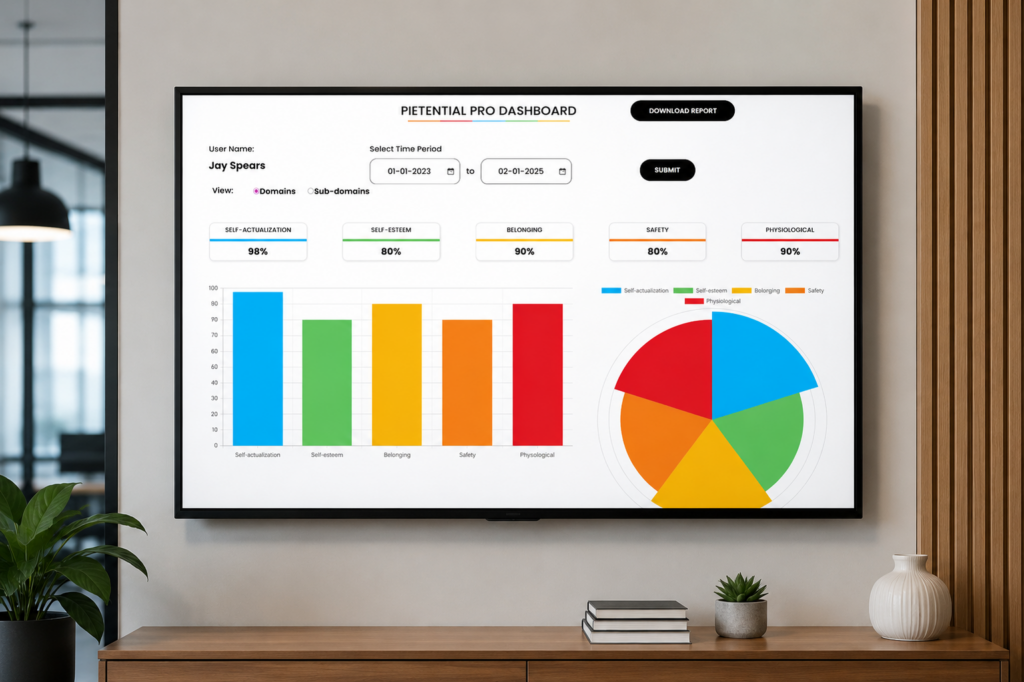
Pietential measures wellbeing across five foundational domains rooted in Maslow’s Hierarchy of Needs — providing individual, cohort, and organizational trend visibility.
For enterprise leaders, this enables:
- Identification of managerial impact on team wellbeing
- Early detection of burnout risk
- Targeted coaching support
- Clear reporting to executive stakeholders
Rather than relying solely on engagement averages or leadership self-assessment, organizations gain evidence of how people are actually doing — and how that is shifting over time.
The result is a narrower credibility gap and stronger leadership alignment.
Final Thought
The Gallup data is not an indictment of managers.
It is a reminder that perception and reality often diverge — especially in complex organizations.
The leaders who close that gap gain more than improved survey scores. They gain trust.
And trust, measured and reinforced through workforce wellbeing insights, becomes a competitive advantage.
Sources
Gallup – Manager Impact on Engagement
https://www.gallup.com/workplace/236927/employee-engagement-drives-growth.aspx
Gallup – Manager Coaching Perception Data
https://www.gallup.com/workplace/394373/why-manager-role-more-critical-than-ever.aspxHarvard Business Review – Why Workplace Wellbeing Programs Fail
https://hbr.org/2019/10/why-your-wellness-program-isnt-working