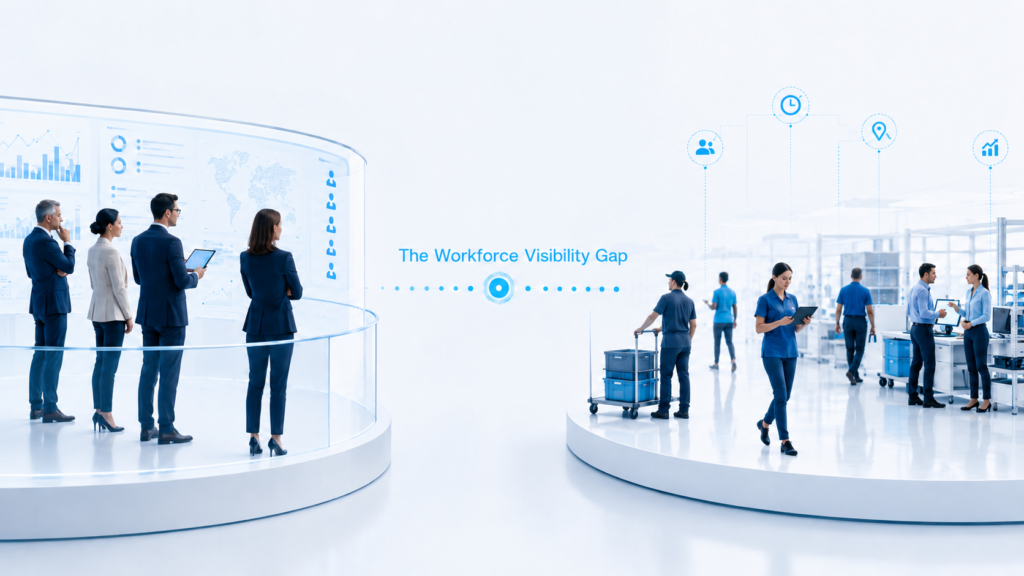
Most executive teams are not managing workforce risk in real time. They’re managing its consequences — after burnout has peaked, after attrition has risen, after engagement has declined. The gap between when conditions form and when leadership sees them is the workforce visibility gap. And it may be the most consequential blindspot in modern Organizational management.
Why it exists
The metrics most Organizations rely on — engagement scores, turnover rates, absenteeism, productivity — are lagging indicators. They reflect conditions that were already in place weeks or months earlier.
By the time an engagement survey shows a significant drop, the trust erosion, manager exhaustion, and workload deterioration that caused it have often been compounding for a quarter or more. By the time attrition rises visibly, the decision to leave has typically been made months before.
This isn’t a failure of data collection. It’s a structural timing problem. Organizations are measuring outputs when what they need is earlier signal about the conditions creating those outputs.
What falls into the gap
The conditions that matter most tend to be exactly the ones that don’t show up in standard dashboards. Psychological safety declining in a specific team. Manager confidence eroding under sustained pressure. Belonging weakening in populations going through Organizational change. Workforce confidence dropping ahead of a performance period.
These are upstream signals. They’re measurable. They appear before engagement drops, before productivity slows, before turnover rises. But they require a measurement approach that most Organizations haven’t yet built.
The cost of operating with a visibility gap
The most obvious cost is response latency. When workforce conditions deteriorate faster than measurement can detect, leadership is always reacting rather than anticipating. Every intervention arrives after the damage has already been done.
The less obvious cost is investment inefficiency. When Organizations can’t measure whether workforce conditions are improving, they can’t determine whether their wellbeing investment is working. They add programmes, expand benefits, and increase spend — without any signal confirming whether any of it is moving the underlying conditions.
What closing the gap requires
Closing the workforce visibility gap requires separating measurement from intervention. It requires an infrastructure that captures the upstream conditions — not just the downstream outcomes — and that operates continuously rather than periodically.
It also requires Organizational willingness to receive signal that may be uncomfortable. A system that shows trust is declining, or that manager exhaustion is spreading into teams, is giving leadership exactly the information they need. But it requires measurement maturity to act on that signal rather than discount it.
The Organizations closing the workforce visibility gap aren’t necessarily investing more in people. They’re investing in seeing their workforce conditions clearly enough to make better decisions earlier.
Pietential is designed to close the workforce visibility gap — with objective, continuous measurement of the upstream conditions that determine workforce health and Organizational performance. Visit pietential.com or reach out to the team directly.