
Most managers believe they know how their teams are doing.
They see attendance.
They observe productivity.
They hear status updates in meetings.
But disengagement and stress rarely present themselves openly.
They accumulate quietly — through rising cognitive load, emotional fatigue, and unmet psychological needs — until the organization feels the impact in attrition, declining performance, or cultural erosion.
The issue is not lack of care. It is lack of visibility.
And in enterprise environments, visibility gaps carry measurable cost.
Assumptions Scale Risk
In organizations with 250–10,000+ employees, frontline managers oversee complex human systems. They juggle delivery targets, development conversations, hiring needs, and operational pressure.
Even highly capable leaders operate with incomplete information.
Gallup research has consistently shown gaps between how leaders perceive engagement and how employees actually experience it. In one widely cited study, 7 in 10 managers rated themselves as strong coaches — while only 2 in 10 employees agreed (Gallup).
This perception gap is not cosmetic. It has consequences.
When managers believe engagement is healthy:
- Burnout goes undetected
- Performance dips are misattributed
- Early retention signals are missed
- Support interventions arrive too late
By the time voluntary turnover rises, the problem has matured into cost.
Burnout Does Not Announce Itself
The World Health Organization classifies burnout as an occupational phenomenon resulting from chronic workplace stress that has not been successfully managed.
It develops gradually — not as a sudden event.
Employees rarely say, “I am approaching disengagement.”
Instead, leaders see:
- Slight withdrawal in meetings
- Reduced discretionary effort
- Delayed communication
- Increased sick leave
- Quiet job searching
When organizations rely solely on annual engagement surveys or pulse checks, these signals remain fragmented.
The result is reactive leadership.
The Productivity and Reputation Impact
Leadership blind spots extend beyond individual teams.
According to research from Deloitte, employee wellbeing is directly connected to productivity and retention outcomes. When employees feel unsupported or misaligned with leadership, performance declines — and turnover risk increases.
In competitive labor markets, reputational risk compounds quickly.
Glassdoor reviews, LinkedIn posts, and peer networks amplify employee sentiment. Organizations that fail to identify and address wellbeing dips early often experience downstream brand impact.
This is why assumption-based leadership is increasingly untenable.
Why Traditional Surveys Don’t Solve the Problem
Surveys provide information. But they rarely provide ongoing intelligence.
Most enterprise organizations run annual or biannual engagement surveys. Some deploy quarterly pulse surveys.
These instruments offer useful snapshots.
But snapshots do not show:
- Month-to-month shifts in stress
- Emerging burnout patterns in specific teams
- Variations across demographic cohorts
- Early indicators of retention risk
Without longitudinal visibility, managers operate with partial insight.
And partial insight creates blind spots.
The Case for Continuous Wellbeing Intelligence
Closing leadership blind spots requires a shift from episodic measurement to continuous intelligence.
Wellbeing intelligence enables organizations to:
- Detect early dips in psychological safety
- Identify emerging disengagement trends
- Surface stress signals before productivity drops
- Equip managers with targeted, evidence-based interventions
This is not about adding more dashboards.
It is about providing leaders with clarity that aligns perception with reality.
When managers have access to consistent, structured insight into team wellbeing, decision-making improves.
Support becomes proactive rather than reactive.
Trust strengthens because employees see action tied to real need.
Replacing Guesswork with Evidence
The cost of assumption is cumulative.
A disengaged employee may remain productive for months before performance declines visibly. A stressed team may meet deadlines while morale deteriorates beneath the surface.
By the time hard metrics move, recovery is expensive.
Evidence-based leadership changes the equation.
With workforce wellbeing intelligence, organizations can:
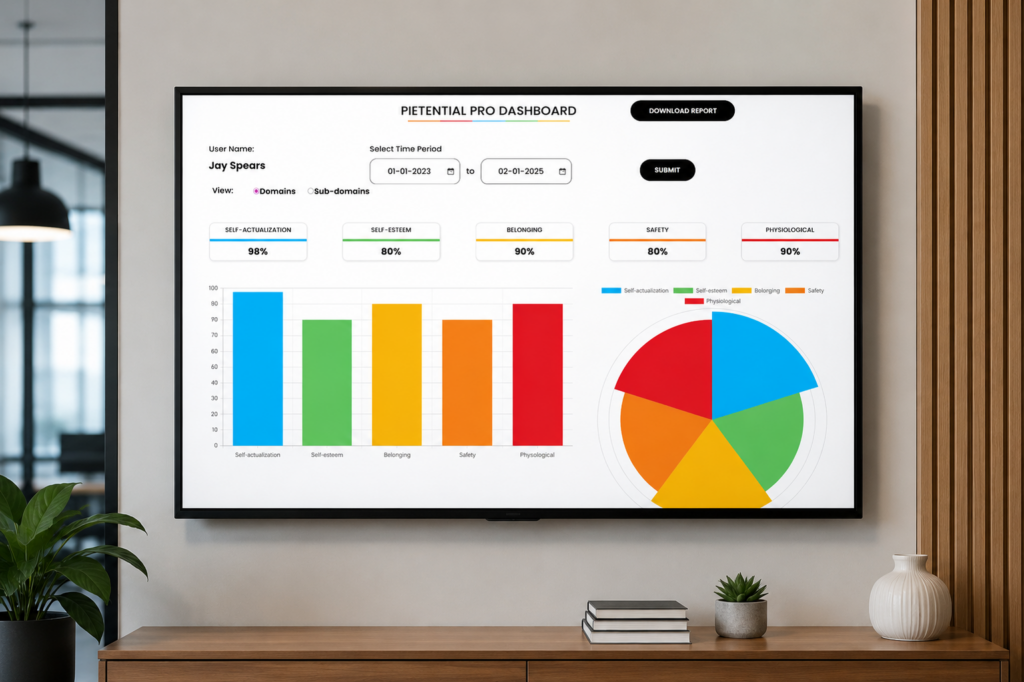
- Replace generalized engagement scores with domain-level insight
- Identify specific unmet needs driving stress
- Align interventions with measurable gaps
- Monitor improvement over time
This transforms wellbeing from sentiment to signal.
Moving from Visibility to Strategic Advantage
In high-performing enterprises, visibility into workforce wellbeing becomes a strategic asset.
It supports:
- Retention planning
- Succession strategy
- Leadership development
- Culture transformation initiatives
- Risk mitigation efforts
When leadership perception aligns with workforce reality, decisions become sharper and more defensible.
The goal is not to eliminate every stressor. It is to ensure stress does not accumulate unnoticed.
Where Pietential Fits
This is where workforce wellbeing intelligence platforms like Pietential play a role.
Rather than functioning as another survey or wellbeing program, Pietential provides structured measurement across five core domains of human need — enabling organizations to track change over time.
For enterprise HR and People Analytics leaders, this supports:
- Early detection of burnout risk
- Cohort-level analysis across departments and demographics
- Clear identification of which initiatives are improving wellbeing
- Evidence-based reporting to executive stakeholders
The shift is simple but powerful:
From assumption → to evidence
From reactive → to predictive
From blind spots → to clarity
Final Thought
Managers care deeply about their teams. But care without visibility is fragile.
In today’s workforce landscape, leadership blind spots are not a matter of intent — they are a measurement gap.
Organizations that close that gap gain earlier warning signals, stronger retention outcomes, and more confident decision-making.
Wellbeing intelligence is no longer optional. It is operational clarity.
Sources
Gallup – Manager Coaching Perception Gap
https://www.gallup.com/workplace/236441/managers-account-variance-employee-engagement.aspx
World Health Organization – Burnout Definition
https://www.who.int/mental_health/evidence/burn-out/en/Deloitte – Workplace Well-being Research
https://www2.deloitte.com/us/en/insights/topics/talent/workplace-well-being.html