

Pietential for THERAPISTS & PRACTITIONERS

Make the Progress You See Measurable
Add a whole-person wellbeing baseline to the insight you already gain through conversation and observation.

Bring Whole-Person Insight to the Therapeutic

Why It Works

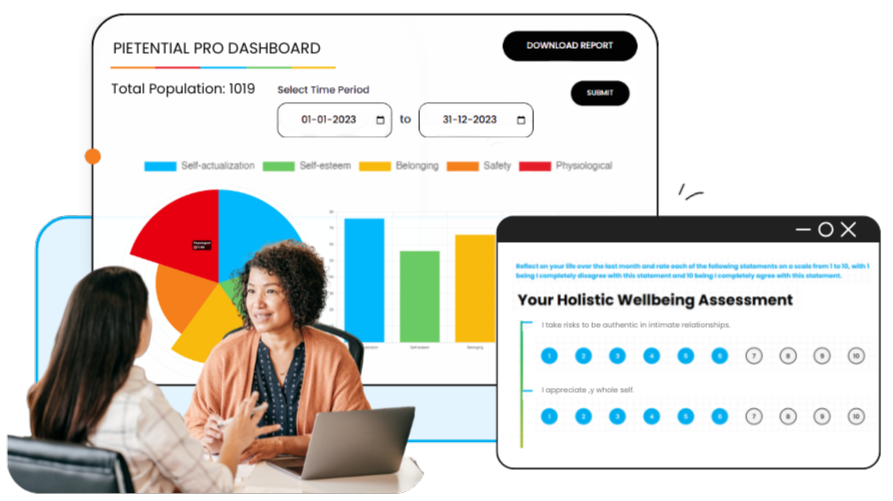
Bring structured wellbeing data alongside clinical observation and client self-report.

Add a holistic view of wellbeing alongside tools focused on specific symptoms or clinical concerns

Give clients access to their own wellbeing results, creating a shared reference point for conversations about progress.

Dr. Amy Athey
BUILT WITH CLINICAL OVERSIGHT

Dr. Amy Athey, Psy.D.

Chief Clinical Officer

Pietential’s clinical development and application are guided by Dr. Amy Athey, Psy.D., Chief Clinical Officer, helping ensure wellbeing measurement supports therapeutic work while remaining distinct from diagnosis and clinical judgment.

How it Fits Into Care

Intake

Establish a whole-person wellbeing baseline before or near the beginning of care. You get a broader view for early treatment planning, while the client sees where they are starting.

Early Sessions

Bring the results into the clinical conversation to explore strengths, concerns, and areas that may deserve further attention.

Ongoing Treatment

Reassess when clinically appropriate to see how wellbeing is shifting across the five dimensions.

Progress Review

Use longitudinal data to review what has changed, support treatment adjustment and documentation, and help clients see their own trajectory.

Practice Insight

For group practices and organizations, view anonymized and aggregated wellbeing trends across the populations you serve while individual results remain centered on the client.

Nedra H. Francis
FROM THOSE DOING THE WORK

Nedra H. Francis

Licensed Psychological Associate & School Psychologist

“This assessment serves as an essential starting point, helping to shape interventions that are deeply aligned with each client’s unique mental and emotional needs.”


Who It's For

For practitioners who want progress to be easier to see
Therapists & Counselors
Psychologists
Behavioral Health Practitioners
Group Practices
Community Mental Health Organizations
School Psychologists & Student-Support Teams
FAQ

Questions Practitioners Ask

No. Pietential is a wellbeing intelligence measurement layer. It does not diagnose mental health conditions or replace clinical assessment, treatment planning, symptom measures, or professional judgment.

They answer different questions. Symptom screeners measure specific symptoms or clinical concerns. Pietential measures whole-person wellbeing across five dimensions of Maslow’s hierarchy of needs, giving you a broader view of how your client is doing and how that picture changes over time.

Yes. Clients receive a private view of their wellbeing in a personal dashboard and can see how their results change from their original baseline over time.

Only with the client’s consent and where sharing has been agreed in advance. Otherwise, individual results remain private.

Use it at intake or early in care to establish a baseline, discuss the results with your client, and reassess at meaningful milestones. It adds measurable wellbeing insight without replacing the way you practice.

No. Pietential measures wellbeing. It is not a diagnostic, crisis intervention, or emergency assessment tool. Practitioners should continue to use their existing clinical protocols and standards of care.

Make Progress
Easier to See

Give clients a whole-person wellbeing baseline they can understand, revisit, and see change against. Bring objective wellbeing measurement into your practice without replacing the clinical tools or judgment you already rely on.

Related Articles