

A layoff can be complete while the workforce is still adjusting to it, so the organization may already look stable on paper. Headcount has stopped falling, resignations have not risen sharply, absence is within the usual range, and teams are still delivering. Those indicators matter because they show whether the business is operating. They do not show whether the people who remain feel secure enough to focus, whether workloads are still sustainable, whether people still feel supported, or whether teams still feel connected.
Gartner’s May 2026 research says employee engagement typically declines before and after layoffs as employees deal with anxiety, insecurity, burnout, and detachment. That supports a practical management need: leaders should measure what happens after the reduction instead of reading a quiet few weeks as proof that recovery is complete.
What leaders can see quickly
Post-layoff dashboards already contain useful evidence. Headcount shows whether the reduction has stopped. Voluntary turnover shows who has already chosen to leave. Absence records show when people are away from work, and performance data shows whether agreed work is still getting done.
These measures become less useful when leaders ask a different question: how is the workforce itself recovering?
Turnover appears after a decision has been made. Absence appears after someone is already away. Performance can remain steady while people are carrying more work or operating with less confidence in the organization. Engagement data adds more context, but it still answers a specific set of questions about employees’ experience of work and the organization.
The issue is therefore not a shortage of dashboards. It is whether the organization directly measures the conditions it wants to understand.
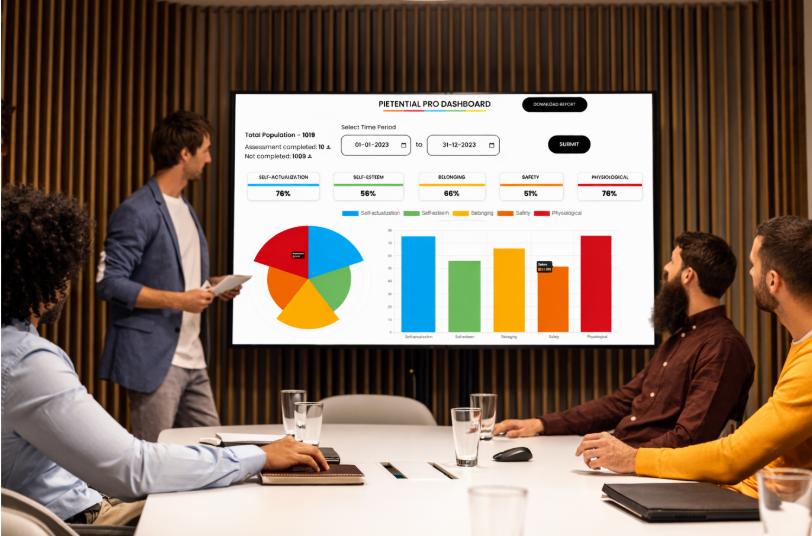
The measurement gap is the variable, not the analytics
Many people analytics tools already provide demographic cuts, cohort analysis, trend monitoring, and predictive risk models. Those capabilities are common and useful.
If leaders want to know whether the remaining workforce is recovering after a reduction, the important question is what variable sits underneath those capabilities.
For example, does the organization directly measure:
- sense of security after the reduction
- workload strain and ability to recover
- belonging and connection
- confidence or self-worth
- clarity about roles and priorities
- sense of growth or purpose
If these conditions are not measured directly, leaders may try to infer them from turnover, engagement, absence, performance, or predictive risk scores. Those proxies can provide clues, but they are not the same as measuring the condition itself.
That distinction affects the management response. A team struggling with role security needs a different response from a team dealing with workload strain, weak belonging, or unclear priorities.
Why a quiet workforce is hard to read
Two teams can look equally stable in the weekly numbers and still be in very different places.
One may understand why the reduction happened, feel clear about priorities, and be settling into the new structure. Another may be meeting the same deadlines while people worry about another round of cuts, absorb work from eliminated roles, or question whether they still see a future in the organization.
Both teams can show stable attendance and output for a period of time. Operational continuity shows that the business is functioning. It still leaves the recovery of the workforce unproven.
Managers often see part of this difference before a central dashboard does. They may spend more time clarifying changed responsibilities, resolving workload conflicts, or answering repeated questions about what happens next. Those observations are useful, but they become more actionable when the organization measures the underlying issue consistently rather than relying on anecdote alone.
What the research says about employees who remain
Gartner published Maintain Employee Engagement Before and After Layoffs on May 11, 2026. Its summary says engagement typically declines around layoffs and recommends greater transparency, clearer priorities, reinforcement of employee value, and rebuilding connection.
Gartner also published separate March 2026 research on sustaining employee performance after reductions in force. It says RIFs can harm performance in the remaining workforce and recommends clarifying roles and expectations and rebuilding the foundations for collaboration.
Recovery should not be assumed from a short period of stable output or headcount. The evidence base is stronger when leaders use direct measures of security, workload, support, role clarity and connection over time rather than relying on a universal recovery timetable.
Academic research adds another layer. A study of a downsized organization found relationships among perceived fairness, commitment and turnover intentions, while field research from Columbia Business School linked employees’ sense of control with commitment and performance after layoffs. A study using 317 firms found a relationship between downsizing and subsequent voluntary turnover.
For leaders, the implication is concrete: workforce conditions can deteriorate before turnover, absence, or performance data makes the change obvious.

How to monitor recovery without overclaiming
A post-layoff measurement plan should separate the questions leaders are trying to answer.
Are people staying? Use headcount and turnover data.
Is work continuing? Use performance and operational measures.
Are employees showing up? Use absence and leave data.
Do employees understand what comes next and feel supported? Use measures designed for confidence, role clarity, security, and support.
Is broader wellbeing recovering? Use a consistent wellbeing measure that captures the conditions the organization has decided matter.
The last question is often where the gap appears. If wellbeing is inferred from several downstream indicators, leaders can see pieces of the picture without knowing whether the underlying condition is improving.
Repeated measurement helps because it shows direction. The goal is not to turn one score into a prediction. It is to see whether security, workload strain, belonging, confidence, recovery, or other defined conditions are improving, flat, or deteriorating over time.
Cohort analysis can then be used in the way modern analytics teams already use it: compare the groups that experienced the reduction differently and look for meaningful divergence. The value comes from the variable being measured, not from segmentation itself.
What leaders should do next?
Start by mapping each post-layoff metric to the question it actually answers.
If headcount, turnover, absence, performance, and engagement cover the questions leaders already understand, identify the question that still depends on inference. For many organizations, that will be whether the underlying wellbeing of the remaining workforce is recovering.
If that condition is not measured directly today, establish a baseline, repeat the same measure at a consistent cadence, and compare movement across the groups most affected by the reduction. Review those changes beside the business data already in use.
When a specific condition deteriorates, investigate the issue behind it. A decline in security, workload sustainability, belonging, support, or role clarity should lead to a different management response.
That gives leadership a more defensible definition of post-layoff stability: the business is operating, and the people carrying it forward are showing measurable signs of recovery.