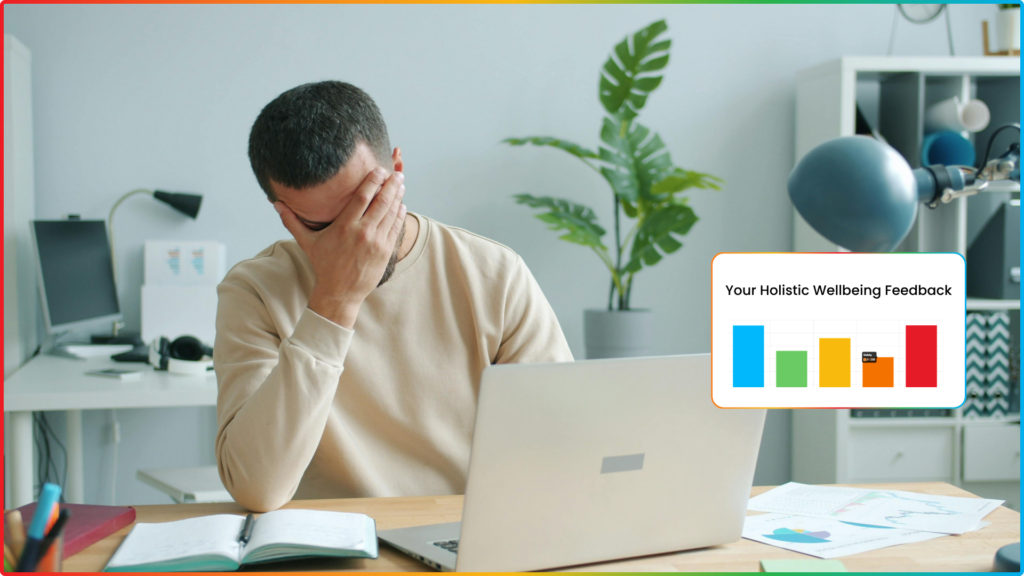

Most organizations that care about employee wellbeing already run surveys. Annual engagement surveys, quarterly pulses, and one-off listening campaigns are common—especially in organizations large enough to require structured data to understand what’s happening across teams.
Surveys aren’t wrong. They’re just limited.
They capture how employees feel at a moment in time. They rarely capture the day-to-day conditions shaping those feelings—and they rarely offer early warning signals that leaders can act on before performance, absence, or attrition show up.
If your wellbeing strategy still relies primarily on periodic survey snapshots, you’re likely measuring sentiment while missing the system.
Why surveys struggle to surface early risk
Survey-based workplace wellbeing measurement has three structural constraints that become more pronounced as organizations scale:
1) Averages blur pockets of strain
Enterprise leaders don’t manage one workforce. They manage many workforces inside the workforce—functions, sites, teams, job families, demographics, and manager ecosystems.
Survey averages often hide meaningful variation. A “stable” overall score can mask a small number of teams with intense workload pressure or low psychological safety—exactly the teams most likely to experience burnout and retention risk.
2) Timing is misaligned with how wellbeing changes
Wellbeing shifts continuously. It moves with workload design, recovery time, change velocity, manager practices, team dynamics, and personal stressors. When visibility is quarterly (or annual), leaders don’t see the slope of change—only the outcome once it’s already formed.
By the time survey results signal a problem, the organization is often already paying for it: lost productivity, rising absence, or quiet attrition among high performers.
3) Surveys are heavy, and response quality decays
As survey volume increases, response quality tends to degrade. Fatigue sets in. Employees become cautious. Managers ask teams to “push through.” The data becomes less precise at the moment leaders need it to be most accurate.
More questions rarely produce more clarity. Better visibility does.
Measurement vs intelligence: the shift leaders need to make
It helps to separate two concepts:
- Measurement tells you what employees report at a point in time.
- Wellbeing intelligence connects signals over time, across groups, and against operational context—so leaders can act with confidence.
In other words: measurement provides a number. Intelligence provides a decision.
For organizations with 250–10,000+ employees, this distinction matters because the objective isn’t to “know the score.” The objective is to manage risk and performance drivers across the system—before they become outcomes.
What “continuous visibility” actually looks like in practice
Continuous visibility isn’t about monitoring individuals. It’s about building a reliable view of wellbeing patterns across the organization so leaders can allocate resources where they matter most.
A practical approach typically includes:
Trend visibility over time
Instead of a single “good” or “bad” result, leaders see directional movement: improving, stable, or deteriorating. This is the difference between reacting to a surprise and managing a trajectory.
Segmentation that supports action
People analytics teams need segmentation that matches how decisions are made: by department, role type, region, tenure bands, demographic cohorts, and manager groups—without turning the analysis into a one-off research project every time.
Early signals aligned to business outcomes
The value of workplace wellbeing data increases when it can be interpreted alongside what leaders already track: engagement, performance, turnover, and absence. The purpose is not to build another dashboard. The purpose is to reduce blind spots and improve prioritization.
How to upgrade your approach without replacing everything
A common misconception is that moving beyond surveys means ripping out existing tools. It doesn’t.
Most organizations already run some combination of surveys, EAPs, wellbeing apps, benefits platforms, and manager training. The gap is not “tools.” The gap is knowing whether those investments are improving employee wellbeing in a way that protects retention and performance.
If you want to progress from survey snapshots to ongoing intelligence, focus on three operational moves:
1) Define what “improvement” means
Before you ask for ROI, define the outcome. For example: reduced burnout risk in a high-turnover segment; improved belonging in a specific function; improved safety in a high-pressure operational site.
2) Build a repeatable cadence for decision-making
Wellbeing should have an operating rhythm—how often leaders review signals, how they escalate patterns, and how they decide what to change. Without cadence, even good data becomes a report that sits in a folder.
3) Close the loop with visible action
Employees don’t lose trust because leaders lack data. They lose trust when nothing changes. When you can connect insight to action—and demonstrate progress—wellbeing stops being “a program” and becomes part of leadership discipline.
Where Pietential fits
For organizations that already have surveys and programs in place, Pietential functions as a wellbeing intelligence layer—rooted in Maslow’s hierarchy of needs—to help leaders objectively measure wellbeing, see patterns across cohorts, and track change over time.
It doesn’t replace EAPs, benefits, or wellbeing programs. It helps answer the question those tools often can’t: is any of this measurably improving wellbeing—and for whom?