
In a competitive market, salaries and perks can be matched. Competitors can mirror your benefits menu, your remote-work policy, and even your employer branding language.
What’s harder to replicate is a culture where workplace wellbeing is measured, proven, and operationalized—not as a campaign, but as a disciplined management practice.
For CHROs and People Analytics leaders, this is the shift: workplace wellbeing is moving from “important” to strategic. Not because it sounds good, but because it shows up in outcomes executives care about—retention, performance stability, risk, and reputation.
Why workplace wellbeing now sits inside talent strategy
Most enterprise organizations already do “something” for employee wellbeing—EAPs, mental health benefits, wellbeing apps, manager training, listening surveys. Yet many still struggle with the same questions:
- Why are high performers burning out despite strong engagement scores?
- Why do certain teams or sites churn faster than the overall average?
- Why does leadership confidence in wellbeing differ from employee reality?
- Which investments are actually improving employee wellbeing versus generating activity?
When those questions go unanswered, wellbeing becomes vulnerable: it gets reduced to participation metrics, treated as discretionary, and debated during budget cycles.
When those questions are answered, wellbeing becomes defensible—and differentiating.
The difference between offering wellbeing and proving it
Many organizations equate availability with impact:
- “We offer a mental health benefit.”
- “We rolled out a wellbeing platform.”
- “We ran a resilience program.”
- “We increased utilization.”
These are inputs and activities. They are not outcomes.
Executives and boards increasingly look for a more mature posture: evidence that people investments are changing conditions in the workforce—especially in roles and segments where attrition risk is expensive.
That’s where the differentiator emerges. In the market, lots of employers can say they care. Far fewer can show that employee wellbeing is improving over time, and that improvements connect to measurable business priorities.
Why “measured wellbeing” creates a competitive advantage
A measurable wellbeing posture strengthens talent strategy in three practical ways.
1) Recruitment credibility in a skeptical market
Candidates have learned to discount promises. They look for signals that wellbeing is real: manager practices, workload expectations, psychological safety, and whether the organization can demonstrate follow-through.
Organizations that can communicate wellbeing as a measured management priority—not a branding claim—create a stronger employer value proposition. It’s not about grand statements. It’s about credible proof points.
2) Retention protection where turnover is most costly
Workplace wellbeing isn’t uniform. Risks cluster in specific contexts: particular functions, manager ecosystems, locations, role types, and change environments.
When leaders can see where wellbeing is deteriorating early, they can intervene before risk becomes resignation. This is especially important for high-skilled and high-cost roles where replacement isn’t simply hiring—it’s ramp time, capability loss, and delivery disruption.
3) Executive confidence during budget and scrutiny cycles
Wellbeing programs often get evaluated like benefits line items: “Is utilization high?” “Is employee feedback positive?” “Did the vendor report good numbers?”
But strategic investments are evaluated differently: “What changed?” “Where did outcomes improve?” “What should we expand, and what should we rethink?”
Organizations that can answer those questions earn more than budget protection. They earn leadership confidence—because decisions are grounded in evidence, not assumption.
The operating model shift: measurement vs intelligence
To create a differentiator, most organizations don’t need “more tools.” They need a clearer operating model for how wellbeing is understood and managed.
A useful distinction:
- Measurement captures a point-in-time reading (often surveys, periodic assessments).
- Wellbeing intelligence builds ongoing visibility into patterns, segments, and change over time—so leaders can act earlier and validate impact.
This matters because talent advantage comes from consistency. You don’t build a stronger employer brand or retention engine on annual snapshots. You build it by managing the system: workload design, team norms, psychological safety, equitable access to support, and leadership capability.
Practical steps to turn wellbeing into a talent differentiator
If you’re trying to make workplace wellbeing “harder to replicate,” focus on these moves:
Establish what “better” looks like
Define measurable objectives that align to talent strategy. Examples:
- Reduce burnout risk in critical roles during peak cycles
- Improve belonging in teams with high regrettable attrition
- Strengthen safety in frontline or high-pressure environments
- Close wellbeing gaps across demographics or work models
Clarity on outcomes prevents wellbeing from collapsing into generic programming.
Segment the workforce for action—not reporting
If you only look at organization-wide averages, you can’t run interventions with precision.
Segment by the realities of your operating model: role families, sites, departments, manager groups, tenure bands, and demographic cohorts (where appropriate). The goal isn’t complexity; it’s decision usefulness.
Build cadence and accountability
Wellbeing becomes strategic when leaders review it regularly, escalate patterns, and own intervention decisions. Without cadence, even good data becomes a static report.
Evaluate impact, not only participation
Participation is a start, but it doesn’t answer the strategic question: did this investment improve employee wellbeing in the cohorts it was meant to support?
That “impact lens” is where many wellbeing efforts stall—and where differentiation is created.
Where Pietential fits
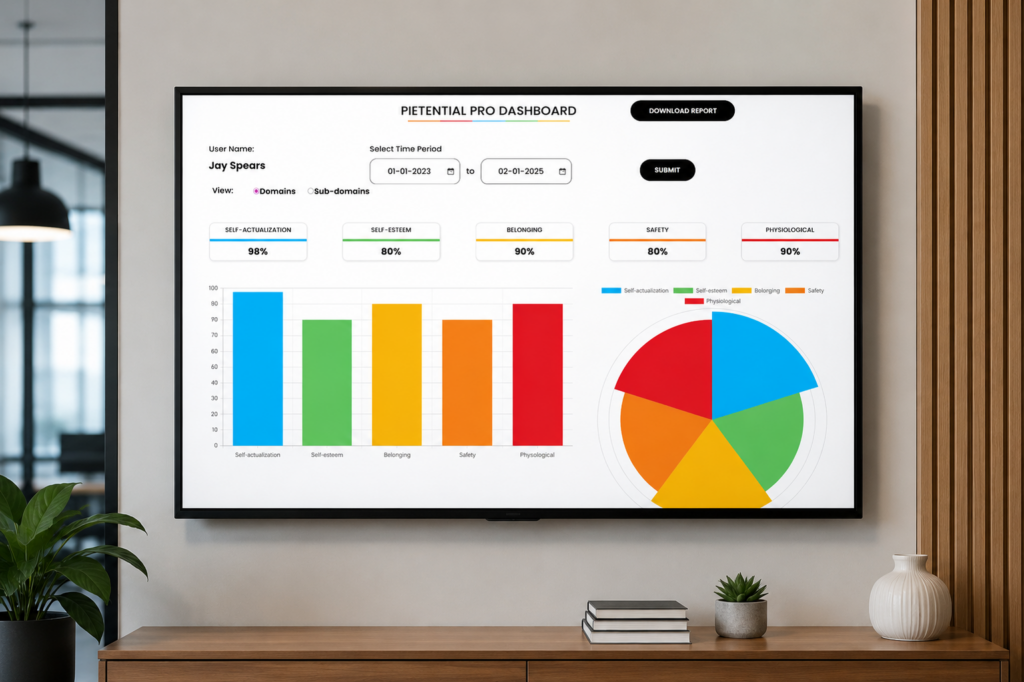
Pietential can serve as a wellbeing intelligence layer—helping organizations measure employee wellbeing objectively and track change over time across core needs (rooted in Maslow’s hierarchy). It is not a replacement for EAPs, surveys, or wellbeing programs; it helps leaders determine whether those investments are improving wellbeing, where gaps persist, and what is moving the margin.