Fred is a veteran struggling to regain his footing after leaving military service.
He has lost another job. He has stopped attending AA meetings. His housing has become unstable. The structure and sense of purpose he once knew are disappearing.
The veteran services organization supporting Fred can connect him with employment resources, benefits, housing assistance and programs designed to help him move forward.

But an important part of Fred’s situation is much harder to see.
His self-worth is falling. His sense of belonging is weakening. He still cares about the people around him, but he is having a harder time taking care of himself.
To the VSO, Fred generates plenty of data.
Those measures describe what Fred did, not necessarily how Fred is doing.
He can attend a job-readiness workshop while his confidence continues to fall. He can receive housing assistance without regaining the sense of security he needs to remain stable.
And if his sense of belonging continues to decline, he may stop showing up altogether.
The VSO can measure the services Fred receives and the outcomes it is expected to produce.
What it cannot consistently measure is the wellbeing of the person receiving those services.

His wellbeing is not being quantified. And because it is not being quantified, the organization cannot examine how changes in his wellbeing may relate to participation, completion, employment, housing stability or return to crisis.
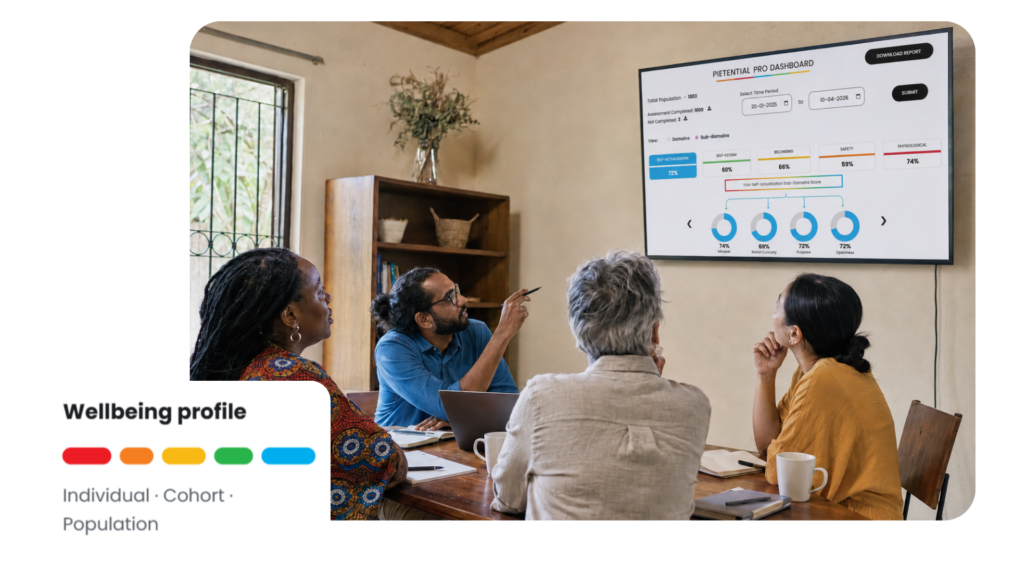
Now imagine that regular Pietential check-ins become part of Fred’s relationship with the VSO.
When Fred visits the veteran center, meets with his mentor or checks in from his phone, he takes a few minutes to update his wellbeing assessment.

Over time, a picture begins to emerge.
Then, one morning, Fred completes another check-in.
His scores have fallen.
Pietential does not diagnose Fred or replace his case worker, mentor, counselor or clinician. It simply makes a meaningful change visible.
Now someone has a reason to ask:
“Fred, what’s going on?”
Perhaps Fred’s mentor learns that he has stopped attending AA. Perhaps his case worker discovers that his housing is in jeopardy. Perhaps they can reconnect him with support before another setback becomes another crisis.
With Fred’s permission, the same picture could also help the different organizations serving him understand more of the person, not only the appointment, application or service that brought him through their particular door.
For Fred, the value is the possibility that someone notices.
For the VSO, the value is greater visibility into where support may be needed, which services appear to be helping and how veteran wellbeing may influence program outcomes.
Across many veterans, the organization could begin examining important relationships.
The answers could help leadership improve programs, coordinate services and direct limited resources where they can do the most good.
They could also help the VSO demonstrate something funders increasingly want to understand:
After 90 days in a mentoring program, a VSO might someday report:
Instead of reporting only how many veterans received mentoring, the VSO could begin showing how veterans changed while receiving it. And how those changes related to participation, completion and stability.
That evidence could strengthen programs, grant applications, donor communications and future funding, ultimately helping the organization reach more veterans like Fred.
Veteran services organizations already measure what they provide and what participants accomplish.
Pietential adds another part of the picture: a consistent way to quantify how veterans are doing and connect changes in their wellbeing with the outcomes the organization measures and is measured by.
Because completing a program is one measure of success.
Helping Fred become the person who can move forward is another.
This illustrative scenario does not describe a specific Pietential customer.