
A merger can be complete on the integration plan while the combined workforce is still adjusting.
Legal close may be complete, systems migrated, reporting lines established, the new operating model in place, and synergy targets on schedule. Those are real integration milestones, but they do not answer whether employees from the two organizations feel secure in their roles, understand the new organization, feel supported by its leaders, work effectively across former company boundaries, or see a future for themselves inside it.
Leaders can therefore have strong visibility into the mechanics of integration while lacking consistent measures of employee adjustment across the combined workforce.
What the impact of mergers and acquisitions on employees can look like
Research on mergers shows that employee adjustment is not one variable. It can involve perceived fairness, identification with the new organization, threat appraisal, engagement, job security, reward, social support, and stress.
A longitudinal study of 215 employees from merging organizations found different adjustment paths for employees from lower-status and higher-status pre-merger groups. Perceived fairness and identification with the new merged organization were related to adjustment over time. A separate three-wave study of 623 employees found that threat appraisal and work engagement were linked across merger phases, with threat appraisal associated with decreases in engagement.
Other research has connected merger periods with job stress and job insecurity, changes in social support, and workforce stress after merger announcements. These findings do not mean every merger produces the same employee response. They do show why a completed org chart is not enough evidence to declare the workforce integrated.
Existing systems already answer part of the question
Many organizations already have tools that can measure parts of the employee experience during a merger.
Employee experience platforms can survey engagement, confidence in leadership, culture, collaboration, and change experience. HR systems can track retention, absence, headcount and role movement. Integration teams can monitor technology migration, process milestones, organizational design and synergy capture. People Analytics teams can compare groups, locations and legacy-company cohorts over time.
Those capabilities are useful and should remain part of the integration scorecard. The remaining question is whether the organization is directly measuring the human variables it needs, or inferring them from proxies and downstream outcomes.
For example, stable retention does not tell leaders whether employees feel secure. A completed systems migration does not show whether cross-team collaboration has improved. An engagement score may show movement in the employee experience, but it does not by itself provide a consistent measure of broader wellbeing across physical strain, security, connection, self-worth and growth.
Workforce integration is better treated as a set of measures
Instead of asking whether the workforce is integrated, leaders can ask which parts of employee adjustment have actually been measured.
Useful variables include role clarity, job security, perceived fairness, leadership confidence, cross-team collaboration, organizational identification, workload, social support, engagement and broader wellbeing. These variables should not be collapsed into one claim about culture or morale because they answer different management questions.
Employee adjustment can begin before operational integration is complete. A merger announcement can affect employees during the sign-to-close period, before systems or reporting structures have changed. McKinsey’s 2025 guidance on extended sign-to-close periods points to uncertainty, talent-retention difficulty, and deal fatigue, and recommends clear communication about roles, responsibilities, and timing. Earlier longitudinal research also documented increased stress and anxiety after a merger announcement.
That makes a baseline useful before leaders wait for turnover, absence, or performance changes to tell them that something has moved. Continuous workforce wellbeing measurement is especially useful during periods when employee conditions may shift several times before operational outcomes change.
Where broader wellbeing measurement can add context
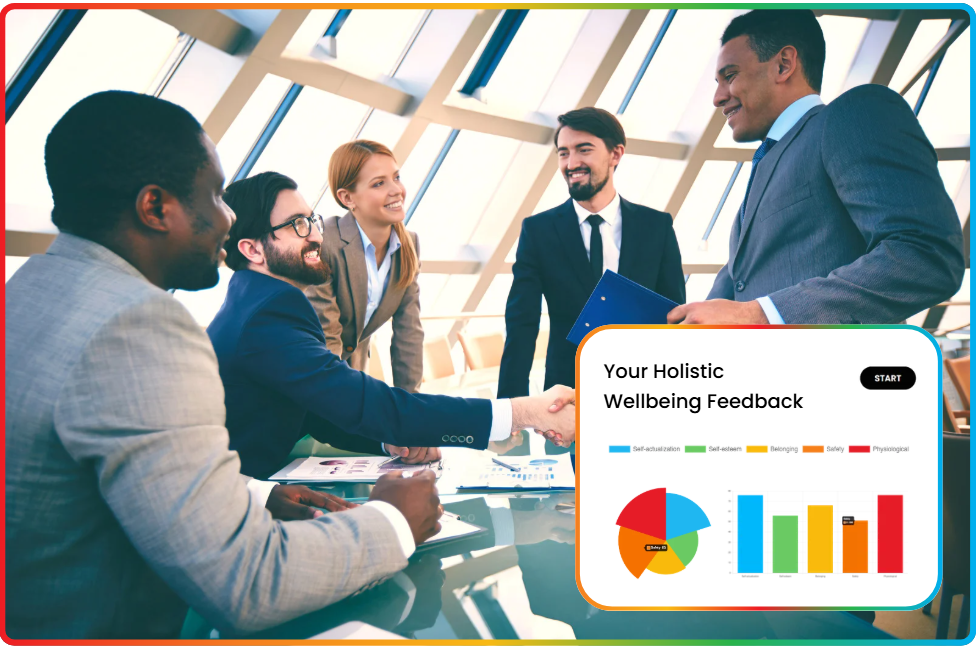
A broader wellbeing measure can sit alongside engagement, HR and integration data rather than replace them.
For Pietential, this means measuring wellbeing across Physiological, Safety, Belonging, Self-Esteem and Self-Actualization domains and following movement over time. External constructs should remain distinct from those domains. Job insecurity may relate to Safety, but it is not the full Safety domain. Social support and organizational identification may relate to Belonging, but they are not the full Belonging domain. Fatigue or stress may relate to Physiological wellbeing without representing the entire domain.
The same boundary applies to business outcomes. A Pietential domain score should not be treated as proof that a merger will succeed, that an employee will leave, or that productivity will rise or fall. The value is an additional direct measure that leaders can compare with operational and employee-experience data while integration unfolds.
A practical integration review
Before calling workforce integration complete, map each integration objective to the evidence being used to judge it. Consultants advising organizations through change can use the same structure to separate operational progress from workforce adjustment.
- Operational integration: systems migration, process completion, reporting structures and synergy milestones.
- Workforce movement: retention, absence, internal movement, and role changes.
- Employee experience: engagement, leadership confidence, fairness, collaboration and identification with the combined organization.
- Broader wellbeing: physical strain and recovery, security, connection, self-worth, and growth or purpose, measured directly rather than inferred from participation or business outcomes.
Then establish a baseline, compare relevant legacy-company and affected cohorts, and repeat the measures at a consistent cadence. If operational milestones are improving while security, fairness, support, or wellbeing are deteriorating in a specific group, investigate that divergence before treating integration as finished.
The useful question is not whether every metric has converged. It is whether leaders can show, with direct measures, how the people carrying the integration are adjusting and where action is still needed.