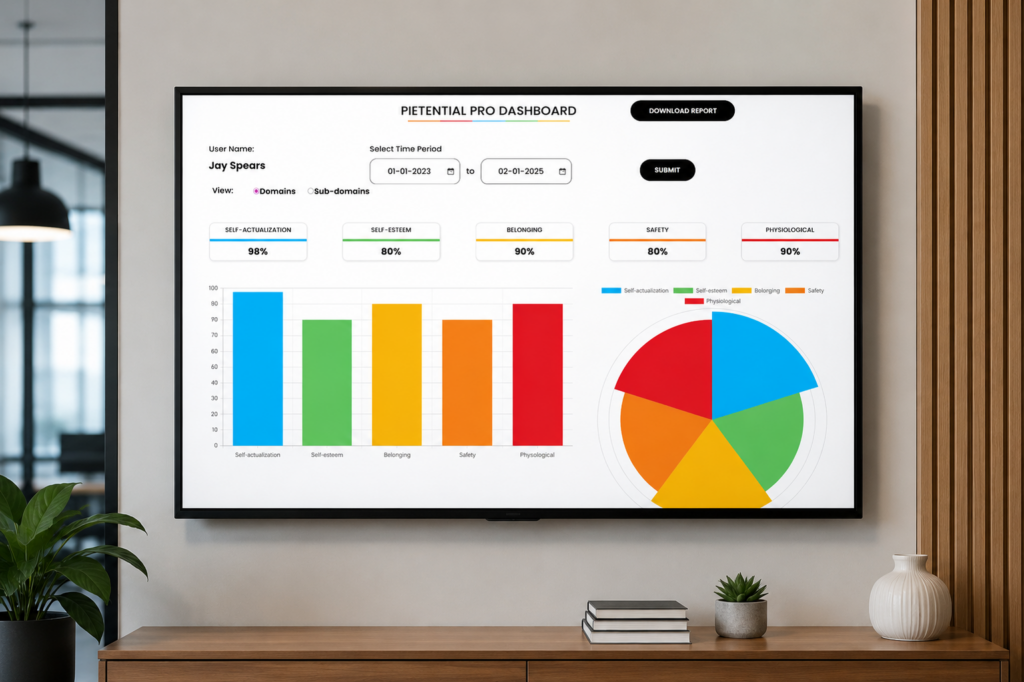

When client wellbeing changes, can they see the journey?
Every coach has felt it: the session where something shifts.
A client sits differently. Their language changes. They name something they have been avoiding. They leave lighter than they arrived. They begin making decisions from a different place.
It is real.
But months later, when that client looks back and asks, “How far have I actually come?” — what do they have?
Those things matter. But they do not always help the client see the full arc of their own transformation.
That is the measurement gap in coaching.
Not a gap in the coach’s skill.
Not a gap in the client’s sincerity.
A gap in the tools coaching has historically had to help people see whole-person wellbeing change over time.
This guide offers a practical framework for closing that gap — by looking at transformation through five dimensions of holistic wellbeing grounded in Maslow’s Hierarchy of Needs.
Seeing the whole person
A Maslow-grounded way to understand client progress
One of the biggest challenges in coaching is not helping people change.
It is recognizing where change is actually happening.
A client may arrive feeling more confident at work. On the surface, that looks like progress. But confidence rarely changes in isolation. It may reflect deeper movement across safety, belonging, self-worth, physical capacity, or purpose.
When we focus on only one area of life, we can miss the bigger picture.
That matters because life coaching is rarely about one isolated goal.
A client may come to coaching because they want a better career, a stronger relationship, more confidence, better habits, more clarity, or a more meaningful life. But the work often reaches across many dimensions at once.
- A career decision may be tied to safety.
- A relationship pattern may be tied to belonging.
- A confidence issue may be tied to self-esteem.
- A lack of follow-through may be tied to physical depletion.
- A feeling of being stuck may be tied to purpose.

Maslow’s Hierarchy of Needs has long given coaches, therapists, educators, and human-development practitioners a way to think about the layers of human wellbeing.
Pietential builds from that familiar construct, but uses it as a modern, non-hierarchical wellbeing model.
In Pietential, the five dimensions are not treated as a ladder where one level must be completed before another matters. They are treated as equally important, interdependent dimensions of a whole human life.
Whole-person change needs whole-person visibility.
La lente de bienestar de cinco dominios
Pietential measures wellbeing through five equally important dimensions grounded in Maslow’s framework:
Fisiológico
- Actividad
- Medio ambiente
- Nutrición
- Dormir
Seguridad
- Seguridad psicológica
- Seguridad espiritual
- Seguridad en la vivienda
- Seguridad Física
Pertenencia
- Amistades
- Compasión Íntima
- Familia
- Comunidad Social
Autoestima
- Autoestima
- Autoconfianza
- Identidad
- Maestría
Autorealización
- Mentalidad
- Curiosidad social
- Propósito
- Apertura
Together, these five dimensions provide a whole-person view of wellbeing.
None of the dimensions outranks the others. A client can appear to be thriving in one area while quietly struggling in another. Those less obvious patterns often shape the coaching conversation far more than the strengths that are easiest to see.
That is why a five-domain lens can be so useful in coaching.
It helps coach and client ask better questions:
- Where is this person strong?
- Where are they constrained?
- What is changing?
- What is not changing?
- Which dimension may be influencing the others?
- What part of life needs attention now?
The goal is not to label the client.
The goal is to help them see themselves more clearly.
A simple exercise coaches can use today
The Five-Domain Reflection
Before introducing any formal assessment, a coach can begin using the five-domain lens as a structured reflection exercise.
Ask the client to consider each area of wellbeing:
Then ask:
This simple reflection can immediately deepen the coaching conversation.
It can help clients move beyond vague answers like “I’m doing okay” or “I feel stuck” and begin naming the dimensions of life that are actually shaping their experience.
But it is still informal.
It depends on the client’s memory, mood, self-awareness, and willingness to say what is true in the moment.
That does not make it invalid.
It just means it is not measurement.
Why the honest limit matters
An in-session check-in can be genuinely useful.
It can surface insight. It can open a better conversation. It can help the client feel seen.
But informal reflection is not the same as an objective, documented wellbeing baseline.
A client’s answer may be shaped by the day they are having, how much they remember, how much they want to please the coach, how safe they feel being fully honest, or how clearly they can see their own progress.
None of that means the client is being dishonest.
It means the process is human.
The difference between informal reflection and reliable measurement is structure.
A structured wellbeing assessment gives coach and client:
A consistent instrument
A documented starting point
A visual profile of wellbeing
A way to reassess at meaningful milestones
A clearer record of change over time
A shared language for discussing the client’s growth journey
That is the layer Pietential adds.
What Pietential makes possible
From reflection to documented wellbeing trajectory
Imagine beginning a coaching engagement with an independent view of your client’s wellbeing across five Maslow-grounded dimensions.
Before or early in the engagement, your client completes the Pietential Wellbeing Assessment independently. By the time you meet, you have a shared, client-facing baseline that helps both of you see the whole picture from the beginning.
As coaching progresses, your client can reassess at meaningful milestones using the same psychometrically validated assessment.
Rather than relying only on memory, conversation, or how someone feels on a particular day, coach and client can explore how wellbeing is changing over time.
The conversation shifts from:
Patterns become visible. Progress becomes easier to discuss. New opportunities for coaching often emerge because both coach and client can see the journey more clearly.
The assessment does not replace coaching.
It helps the coaching conversation become more focused, more grounded, and more connected to the client’s whole life.
What Pietential is — and is not
Pietential is an Independent Wellbeing Intelligence System.
It measures holistic wellbeing across five Maslow-grounded dimensions and twenty subdomains. It gives clients a visual profile of their wellbeing and allows coach and client to track change over time through reassessment.

Pietential is:
- A psychometrically validated wellbeing assessment
- A way to establish an objective, documented wellbeing baseline
- A client-facing visualization tool
- A longitudinal way to track wellbeing over time
- A structured framework for coaching conversations
- Una capa de medición independiente
Pietential is not:
- Therapy
- Medical advice
- Mental health treatment
- A diagnostic tool
- A coaching replacement
- A wellness app
- A personality test
- An intervention marketplace
The coach remains the coach.
The client remains the owner of their growth journey.
Pietential simply makes holistic wellbeing more visible, measurable, and discussable over time.
How this changes the coaching conversation
When coach and client can see wellbeing across five Maslow-grounded dimensions, the conversation becomes more specific.
This does not tell the coach what to do.
It helps coach and client ask better questions.
It helps reveal where the next layer of the work may be.
Why independent measurement matters
Many tools in the wellbeing space also sell programs, interventions, apps, content, coaching, referrals, or recommendations.
Pietential is different.
- We measure wellbeing.
- We do not provide coaching.
- We do not replace the coach.
- We do not sell clients a competing intervention.
- We do not direct clients away from the coaching relationship.
This matters because coaching is relational work.
The measurement layer should support the relationship, not compete with it.
Pietential gives coach and client independent wellbeing data they can use inside the coaching process — without turning the assessment into another program to manage.
Explore the Pietential Coach Partnership
If the Five-Domain Reflection is useful, the next step is seeing what an independent, validated version of that framework could do for your practice.
Pietential helps coaches:
- Establish objective, documented wellbeing baselines
- Give clients a visual way to understand their own wellbeing
- Track change over time through reassessment
- Focus coaching conversations more clearly
- Support more meaningful progress reviews
- Differentiate their practice with independent wellbeing measurement
- Help clients see the whole-person journey of change
Most coaches begin by using Pietential with a small group of clients, then decide whether it belongs more broadly in their practice.
Great coaching helps people change.
Pietential helps coach and client see how holistic wellbeing is changing over time.
That is the missing measurement layer.
Independent Wellbeing Intelligence System — Pietential