
Foreword
Pietential was not built as an enterprise software product. It was built as a peace project, a conviction that wellbeing measurement should not be a privilege available only to organizations with large budgets and sophisticated analytics teams.
The same science that helps a Fortune 500 organization understand whether its workforce is stable enough to execute its strategy can help an NGO understand whether its community programs are working, for whom, and by how much.
This whitepaper is written for the leaders, program directors, monitoring and evaluation teams, and funders who are trying to do measurable good in the world, and who recognize that good intentions, without good measurement, cannot be scaled, defended, or sustained.
For NGOs and nonprofits, wellbeing is increasingly something organizations must measure to prove a program works. Until now, the data layer to do it didn't exist. Pietential is that layer.


The Problem the Social Sector Has Always Had
Every NGO/NPO working in community development, health, education, livelihoods, or social protection faces a version of the same challenge:
How do you prove that what you are doing is actually working?
Activity metrics are easy. Number of workshops conducted. Number of beneficiaries reached. Percentage of target population enrolled. These metrics are reportable, but they say nothing about whether the lives of the people you serve have materially improved. Funders increasingly understand this distinction and increasingly require something more.
Whether the people you serve feel safe, experience belonging and self-worth, or see their sense of stability improve, none of this shows up in a headcount. It requires structured, validated, longitudinal measurement, conducted against a scientific framework that can be defended in a board presentation or a funding proposal.
Most organizations in the social sector have never had access to that kind of measurement infrastructure. Academic tools are too complex. Custom surveys are too resource-intensive and are often not science-backed. Anecdotal reporting is too subjective. And most wellbeing tools built for the corporate market are priced, designed, and framed for an audience that is not the communities NGOs serve.
Pietential closes that gap.

What Pietential Is - For the Social Sector
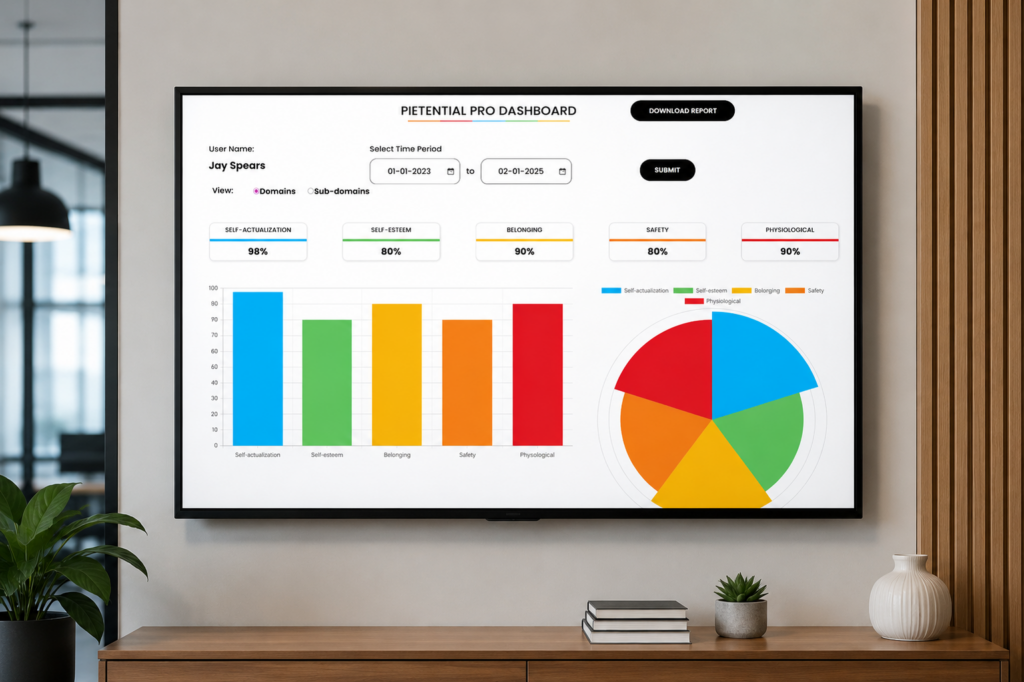
Pietential is a holistic wellbeing intelligence platform grounded in Maslow's Theory of Needs. It provides NGOs, nonprofits, and social impact organizations with a structured, validated, and scalable tool to measure, monitor, visualize, and demonstrate the wellbeing of the communities and populations they serve.
The assessment framework evaluates wellbeing across five domains: Physiological, Safety, Belonging, Self-Esteem, and Self-Actualization, and twenty subdomains (sleep, nutrition, activity, environment, psychological safety, physical safety, dwelling safety, spiritual safety, friendships, family, intimate compassion, social community, mastery, identity, self-confidence, self-worth, purpose, mindset, openness, and social curiosity) that together constitute the Holistic Wellbeing Assessment.
What Pietential produces is not a survey result. It is a longitudinal wellbeing intelligence layer, a structured baseline against which program impact can be measured, compared across demographic groups, and reported with scientific credibility to funders, field directors, government partners, and peer organizations.

La ciencia detrás de la medición
Pietential's framework derives from one of the most widely recognized psychological models for understanding human motivation in the history of human science. Maslow's Theory of Needs is a universally recognized framework for understanding what human beings need to flourish. Reverse-engineered, adapted, and validated for Pietential's assessment architecture, it produces domain and subdomain scores that are:
through Pietential's assessment process with items designed for reliability and consistency across populations and cohorts.

every assessment is timestamped and stored against a unique individual identifier, enabling trend analysis across measurement cycles.

scores can be analyzed and compared across gender, age, education level, caste, occupation, marital status, geographic location, and any custom demographic attributes the organization desires.

the platform generates cohort averages, comparative analyses, and population-level intelligence without requiring manual aggregation or specialist data skills.

The result is a measurement framework that is structured enough to support rigorous review and stakeholder scrutiny, accessible enough to be administered by volunteer social workers in remote villages, and structured enough to produce the evidence base that funders and policymakers require.
What the Evidence Shows
Pietential has been deployed in real-world social impact contexts across India, producing results that demonstrate both the power of the measurement framework and the practical utility of the platform for community-based organizations.

Case Study One: VaJaHa Foundation, Madhya Pradesh, India
The VaJaHa Foundation deployed Pietential to benchmark the holistic wellbeing of rural communities near the Pench and Kanha National Park regions - 6,414 individuals across 119 villages in three districts.


Forty social work volunteers administered the 20-question assessment verbally in Hindi over four months, due to exceptionally low literacy rates.
The findings produced insights that no conventional program evaluation tool would have surfaced.
Safety scores remained remarkably stable across educational levels - ranging from 74% to 80% regardless of educational attainment. This counterintuitive finding led to deeper community interviews that revealed something important: communities living in close proximity to apex predators had developed collective coping mechanisms that maintained a consistent sense of safety irrespective of individual educational background. That is an organizational and policy insight. It could not have been discovered without a validated, domain-level measurement framework applied at population scale.
Income showed a nominal correlation with wellbeing. A tenfold increase in monthly income - from below INR 2,000 to above INR 20,000 - produced only a 2.4% increase in holistic wellbeing. This finding, validated through the Pietential framework, directly challenged the assumption that economic improvement alone would be sufficient to enhance community wellbeing, and provided VaJaHa with a defensible evidence base for arguing that holistic, non-financial interventions are necessary for genuine progress.

Case Study Two: PBSS, Korku Tribes, Narmadapuram
The Prerit Bhauuddeshiya Sanstha Samiti used Pietential across a two-phase longitudinal study of 1,000 individuals from the Korku tribal community, the fourth-largest indigenous community in India, across 114 villages.


The pre-assessment established a domain-level baseline. The organization then designed and delivered targeted interventions - health programs, document assistance camps, digital literacy training, legal awareness workshops, and vocational training for widowed individuals. Six months later, the post-assessment was administered. The results demonstrated measurable, domain-specific improvement across the population.
Gender-focused interventions produced a 22% increase in Self-Actualization, 16% increase in Belonging, 13% increase in Physiological wellbeing, 9% increase in Self-Esteem, and 7% increase in Safety among women - associated with the programs implemented during the intervening period.

Lifestyle Adjustment Programs produced a 12% increase in Self-Esteem, 9% increase in Self-Actualization, 7% increase in Safety, 5% increase in Physiological wellbeing, and 4% increase in Belonging across the full population.
Vocational training for widowed individuals - who started from substantially lower baseline scores than married or unmarried peers - produced meaningful improvements across all five domains, with Belonging increasing from 48% to 55%, Physiological from 46% to 54%, and Safety from 50% to 58%.
These are not anecdotal reports. They are pre/post measurement results produced by the same validated psychometric instrument, administered by trained social workers, and analyzed through Pietential's platform features - comparative analysis, cohort segmentation, population average tracking, and longitudinal trend visualization.
This is what it means to have the ability to prove that a program works.

What Pietential Enables - For NGO and Nonprofit Leaders

Baseline Benchmarking:
Before a program begins, establish a validated wellbeing baseline across the target population. Understand where each domain stands, which subdomains are most under pressure, which demographic groups are most vulnerable, and how the population compares to broader demographic norms. This baseline is not just a starting point, it is the scientific foundation of every impact claim the organization will make.

Gap and Comparative Analysis:
Pietential's comparative analysis feature enables organizations to compare wellbeing across demographic groups simultaneously - gender, age, education level, caste, marital status, geographic location, or any custom attribute configured during setup. This is the layer that transforms population data into intervention intelligence. It tells you not just how your population is doing but where the gaps are, which groups are furthest behind, and where resources may have the most concentrated impact.

Monitoreo y Evaluación de Programas:
Pietential supports structured monitoring and evaluation through repeated assessment cycles. Organizations can track whether wellbeing is improving across domains during a program, identify which components of an intervention are producing movement and which are not, and adjust program design in real time based on observed data rather than intuition. This is continuous improvement grounded in measurement - not in observation alone.
Post-Program Impact Measurement:
At the close of a program cycle, the post-assessment produces a direct, domain-level comparison against the pre-assessment baseline. The result is a defensible, quantified impact statement: wellbeing in the Safety domain improved by 7% following the implementation of targeted health and safety programs. Self-Actualization increased by 22% following women's empowerment interventions. These numbers, generated by a validated psychometric tool and presented through Pietential's visualization features, are the evidence base that funders, government partners, and boards require.
Longitudinal Tracking:
For organizations committed to sustained community engagement, Pietential's longitudinal tracking capability enables wellbeing monitoring across multiple program cycles over time. As each assessment cycle contributes to the individual's record, trend lines emerge that show not just whether a community improved after one program but whether those improvements held, whether they deepened, and whether new areas of vulnerability emerged that require attention.
Funder Reporting and Stakeholder Communication:
Pietential's export and reporting features enable organizations to produce structured, visualized wellbeing reports suitable for funder presentations, annual reports, grant applications, and regulatory submissions. The framework's scientific grounding and the platform's psychometric validation provide the third-party credibility that differentiates rigorous impact measurement from self-reported program success narratives.


The Holistic Wellbeing Index - A Universal Framework for Community Progress:
The five domains and 20 subdomains of Pietential's Holistic Wellbeing Assessment are designed for human beings - which means they apply with equal relevance to an urban refugee population in the Middle East, a marginalized women's collective in sub-Saharan Africa, a community in a developed country navigating environmental stress and livelihood rights, a workforce development program serving formerly incarcerated individuals in the United States, a youth mental health initiative in a mid-sized American city, or an indigenous community preserving cultural identity while integrating into modern economic systems.
| Dominio | What it measures in community contexts |
|---|---|
| Fisiológico | Sleep, Nutrition, Activity, Environment- the biological foundation of human capacity |
| Seguridad | Psychological Safety, Physical Safety, Dwelling Safety, Spiritual Safety - the conditions that precede stability and trust |
| Pertenencia | Friendships, Family, Intimate Compassion, Social Community - the relational fabric of resilience |
| Autoestima | Mastery, Identity, Self-confidence, Self-worth - the psychological foundation of agency and participation |
| Autorealización | Purpose, Mindset, Openness, and Social Curiosity - the conditions that enable human potential and sustained change |

These are not abstract constructs.
They are the dimensions of human experience that determine whether a person can benefit from a program, sustain a behavior change, participate in civic life, or transmit opportunity to the next generation. When an organization knows where a community stands across all five dimensions, and tracks how that changes over time, it knows something genuinely meaningful about whether its work is contributing to human flourishing.
For Program Evaluators and Monitoring & Evaluation Teams
The Pietential wellbeing intelligence system maps directly onto established monitoring and evaluation methodologies. The pre/post assessment structure mirrors standard evaluation design. The domain and subdomain architecture enables distinction between short-term, intermediate, and long-term outcome indicators. The comparative analysis feature supports equity-focused evaluation, enabling disaggregation by gender, age, caste, education, marital status, and geographic location, and other relevant attributes. The longitudinal tracking capability supports process evaluation - understanding whether change is occurring during a program, not only after it concludes.
For M&E teams working under results-based management frameworks, Pietential provides a validated instrument that produces structured, quantified, defensible evidence across the domains most commonly referenced in social sector outcome frameworks: safety and security, dignity and self-esteem, social cohesion and belonging, and human capability and self-actualization.
The platform does not replace M&E expertise. It gives M&E teams the measurement infrastructure they have previously had to build from scratch - validated, scalable, and immediately deployable.
The Vision - Wellbeing for All. Everywhere.
Pietential was founded on a conviction that became a mission: wellbeing measurement should not be a resource available only to organizations wealthy enough to commission it or sophisticated enough to build it.
The same rigor that serves a multinational corporation trying to understand whether its workforce is stable enough to execute its strategy should be available to a nonprofit trying to understand whether its community programs are producing genuine human progress.
That is not a feature request. It is a founding principle.
Wellbeing is the real measure of progress. And progress that cannot be measured cannot be claimed, scaled, defended, or sustained.
Pietential makes wellbeing measurement possible - for everyone working to advance it.
Next Steps
For NGO and nonprofit leaders seeking to establish a validated wellbeing measurement framework for their programs: Pietential's onboarding process is designed for social sector organizations and can be initiated without a large technical team or specialized data infrastructure.
For funders and philanthropic organizations seeking to establish consistent wellbeing measurement standards across their grantee portfolios: Pietential provides a common framework and platform that enables cross-program comparison, aggregate impact reporting, and evidence-based grantmaking.
For corporate CSR and sustainability teams seeking to measure the community impact of their social investment programs: Pietential's platform enables measurement of community wellbeing outcomes using the same framework deployed internally for workforce wellbeing - creating a connected, credible impact narrative from workforce to community.
Visit: www.pietential.com Contact: support@pietential.com