
Introducción
Therapy creates change. Some of it is hard to make visible.
Los terapeutas ven el cambio todos los días.
Un cliente empieza a dormir mejor. Se siente más seguro/a en su cuerpo. Se reconecta con su familia. Establece límites. Recupera la confianza. Empieza a imaginar un futuro de nuevo.
Some of that change shows up in the screeners you already use. Some of it shows up in your session notes. Some of it shows up in the client’s own words, session to session.
But the broader arc — the whole-person wellbeing trajectory that therapy so often helps restore — can be hard to hold in one place, hard to show the client, and hard to revisit months later.
That is what this guide is about.
Therapists already have strong tools for the clinical questions in front of them: assessment, diagnosis, symptom severity, risk, and treatment planning. Those tools do essential, specific work. Pietential is not one of them and does not try to be.
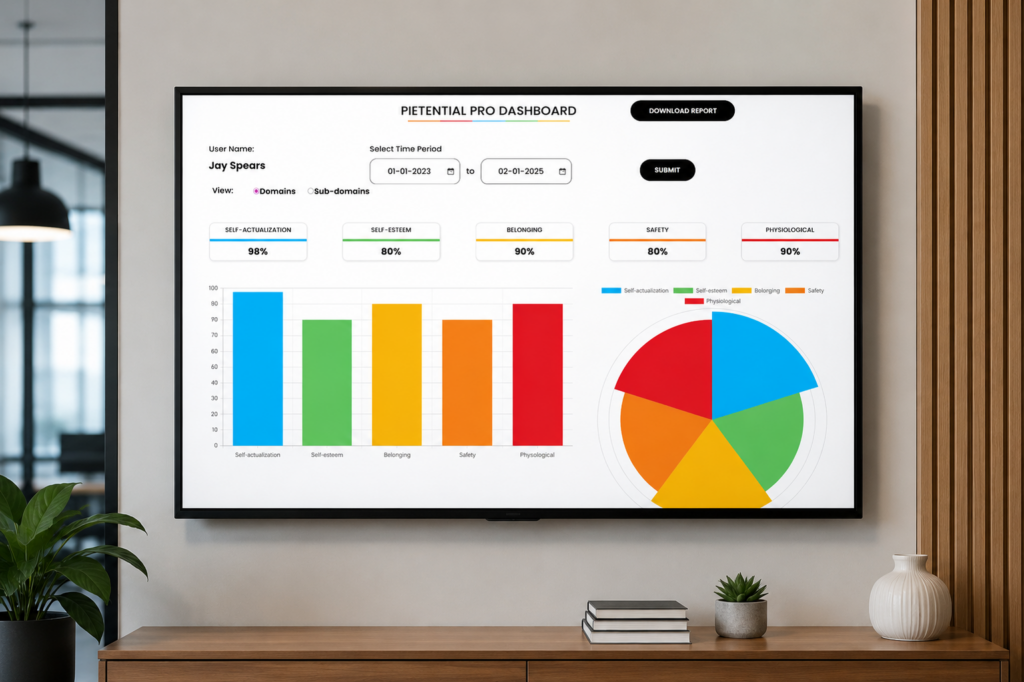
Pietential gives therapists and clients something different: a shared, structured picture of holistic wellbeing across five core dimensions and twenty subdomains. Both therapist and client can see it and return to it before or near the beginning of care, during care, and over time.
For the client, Pietential makes wellbeing visible in a way they can understand, revisit, and monitor.
For the therapist, it creates a reliable whole-person reference point that can support therapeutic conversation, progress review, and documentation.
For a group practice, clinical director, or community-based organization, it can provide anonymized, aggregate insight into wellbeing patterns across the people being served.
What This Guide Covers
In this guide, we will explore:
- Two things that are genuinely hard to make visible in therapeutic work
- Why holistic wellbeing deserves its own structured, client-facing view
- The five core dimensions Pietential measures as a whole-person profile rather than a hierarchy
- How a longitudinal wellbeing picture can support intake, treatment conversations, progress review, and documentation
- What a practice owner, clinical director, or community-based organization can see across the people it serves
- Common mistakes that turn measurement into paperwork instead of part of the work
- Why an independent measurement layer protects the primacy of the therapeutic relationship
What Is Hard to Make Visible
Picture a client who tells you they finally feel more like themselves: steadier, more connected, more hopeful.
How do you show them how far they have come?
And across everyone your practice serves, how clearly can you see where people are gaining ground, where they are still under strain, and where wellbeing needs may be emerging across the population?
These are hard things to make visible, not because clinical tools fall short, but because they were built for something else.
Mental health care has many established tools for measuring symptoms, risk, diagnosis-specific severity, and client distress. Tools such as the PHQ-9 and GAD-7 serve important purposes: screening for symptoms, monitoring severity, and supporting clinical decision-making within the appropriate scope of care. A good EMR reports on them well.
That work is essential, and Pietential does not touch it.
There are two things, though, that those instruments were never designed to do. Both matter in therapeutic work, and both are hard to make visible without a structured, whole-person wellbeing view.
Pietential is not a better screener, and it is not trying to be one.
It does two things a symptom instrument was never built to do:
- It gives the client a visual, whole-person picture of their own wellbeing that they can see and return to.
- It gives a practice, clinical director, or community organization an anonymized, aggregate view of wellbeing across the people it serves.
1. The Client Rarely Gets to See Their Own Wellbeing Trajectory
Progress is often tracked through clinical notes, client narrative, observation, and professional judgment. Those are the heart of the work.
But the client seldom gets to see their own wellbeing laid out across the dimensions of their life, and even more seldom gets to watch it change.
You may know meaningful change is happening. The client may feel some difference. But without a structured picture they can hold, the trajectory often stays inside the room and inside the notes. It is rarely structured, visualized, and made trackable for the client in one place.
Pietential helps make that trajectory visible. It gives the client a whole-person profile they can understand, revisit, and discuss with the therapist over time.
2. A Whole Practice Has No Structured Way to See Wellbeing Across the People It Serves
The second thing is one no single set of session notes can give you: a view across everyone served by a practice or organization.
A clinical director, group practice, or community mental health team may understand individual cases deeply. But without an aggregate wellbeing view, it is difficult to see how wellbeing is distributed across the population, where it is strengthening, and where it remains under strain.
This is not a clinical diagnosis question. It is not a replacement for symptom tracking, risk assessment, or treatment planning.
It is an organizational visibility question.
For practice leaders and community-based organizations, Pietential can provide a picture that is difficult to get any other way: a structured, anonymized view of holistic wellbeing across the population being served.
That view can help leaders understand needs, evaluate programming, support quality conversations, and communicate impact more clearly.
What This Makes Possible
Neither of these needs is a shortcoming of clinical measurement. They are simply different jobs.
Clinical instruments answer clinical questions.
Pietential supports a broader wellbeing question:
How is this person’s whole-life wellbeing changing over time, and what can we learn from that picture at the individual and aggregate level?
A measurement framework for that broader picture should:
That is where holistic wellbeing measurement becomes useful.
The Framework
Five dimensions. Twenty subdomains. One whole-person view.
Pietential measures wellbeing across five core dimensions of human need:
- Fisiológico
- Seguridad
- Pertenencia
- Autoestima
- Autorealización
These dimensions are grounded in Maslow’s framework and adapted into a non-hierarchical model of wellbeing.
Pietential does not treat these dimensions as a pyramid where one level matters only after another is satisfied. It treats them as five interdependent, equally weighted dimensions of a whole person.
Not a hierarchy.
A whole-person profile.
Each dimension includes subdomains that give a fuller view of how the client is experiencing life. Together, the five dimensions and twenty subdomains create a structured way to see holistic wellbeing and to watch it change over time.
The Five Dimensions of Holistic Wellbeing
Physiological Wellbeing
Physiological wellbeing reflects the physical foundations of daily life: energy, rest, bodily needs, and the client’s capacity to sustain basic functioning.
In therapy, this dimension may be relevant when clients are experiencing disrupted sleep, low energy, appetite changes, chronic stress, fatigue, or difficulty maintaining daily routines.
Changes here may signal that the client’s basic capacity for daily life is beginning to shift.
This does not replace medical assessment or clinical evaluation. But it gives therapist and client a structured way to notice how physical wellbeing connects to the broader picture.
Seguridad
Safety reflects the client’s sense of stability, security, predictability, and emotional safety.
This may include how safe the client feels in their environment, relationships, finances, body, or life circumstances.
For many clients, perceived or actual instability can affect their ability to engage in growth-oriented work. Monitoring Safety over time can help therapist and client understand whether the client’s sense of stability is improving, holding, or remaining constrained.
Safety is not merely the absence of immediate crisis. It is part of the client’s lived experience of being able to function, trust, plan, and engage.
Pertenencia
Belonging reflects connection, relationship, community, and the experience of being seen and accepted.
Many clients enter therapy feeling isolated, disconnected, unseen, or unsupported.
Monitoring Belonging over time can help therapist and client explore whether the client’s relational world is changing: whether they are reconnecting, building support, strengthening trust, or still struggling with disconnection.
Autoestima
Self-Esteem reflects self-worth, confidence, agency, capability, and the client’s belief in their ability to affect their life circumstances.
Many therapeutic journeys involve rebuilding a damaged or diminished sense of self.
A client may begin to recognize strengths, make choices, set boundaries, take healthy risks, or move with greater confidence.
A structured view of Self-Esteem over time gives therapist and client a way to observe whether this dimension is shifting.
Autorealización
Self-Actualization reflects purpose, meaning, growth, creativity, aspiration, and the client’s movement toward the life they want to build.
This dimension matters because therapy is often not only about reducing distress. It is also about helping people reconnect with possibility.
A client may become more able to make autonomous decisions, pursue meaningful goals, express creativity, imagine a future, or live with greater alignment.
Self-Actualization helps capture that movement from coping toward growth.
Where This Helps in Therapeutic Work
It Creates a Broader View of the ClientA client may come to therapy for anxiety, depression, grief, trauma, relationship distress, or a life transition. But the effects of those experiences usually extend across many areas of life...
A client may come to therapy for anxiety, depression, grief, trauma, relationship distress, or a life transition. But the effects of those experiences usually extend across many areas of life.
A whole-person profile shows how wellbeing is distributed across the five dimensions, surfacing areas of strength, areas of strain, and areas that may deserve further exploration.
It Gives You a Shared Reference for the ConversationA visual wellbeing profile gives therapist and client something concrete to discuss, alongside the clinical work rather than instead of it. Rather than relying only on memory...
A visual wellbeing profile gives therapist and client something concrete to discuss, alongside the clinical work rather than instead of it.
Rather than relying only on memory, narrative, or the presenting problem, the therapist can ask:
- ¿Qué se siente preciso aquí?
- ¿Qué te sorprende?
- Which dimension feels most important right now?
- Where do you see strength?
- Where do you feel stuck?
- What would meaningful movement look like?
The data does not tell the therapist what to do. It helps open a more informed conversation.
It Helps Clients See Their Own ProgressMany clients struggle to recognize progress while they are living through it. They may feel better but not trust it. They may improve in one area...
Many clients struggle to recognize progress while they are living through it. They may feel better but not trust it. They may improve in one area while continuing to struggle in another. They may forget where they began.
A client-facing wellbeing view can help clients see their own experience more clearly. This can support insight, engagement, and ownership of the therapeutic process.
It Creates a Record of TrajectoryA baseline shows where a client started. The value grows when the client reassesses over time. Longitudinal wellbeing measurement helps therapist and client see...
A baseline shows where a client started. The value grows when the client reassesses over time.
Longitudinal wellbeing measurement helps therapist and client see what has changed, what has held steady, and what may need continued attention.
The question is not simply, “Where is the client today?”
The deeper question is, “How is this client’s wellbeing changing over time?”
It Gives the Practice a View It Cannot Get from Individual Notes AloneFor a clinical director, group practice, or community organization, individual notes do not add up to a population-level wellbeing picture. With appropriate consent...
For a clinical director, group practice, or community organization, individual notes do not add up to a population-level wellbeing picture.
With appropriate consent and anonymization, Pietential can show aggregate wellbeing trends across the people a practice serves: where wellbeing is strengthening, where it is under strain, and how it is moving over time.
This is a leadership and program-level view, kept separate from any individual client’s clinical record.
It helps a practice understand not only what is happening case by case, but what may be happening across the population it serves.
It Complements Clinical JudgmentPietential is not a substitute for clinical training, diagnosis, treatment planning, risk assessment, or therapeutic skill. It is a structured wellbeing view...
Pietential is not a substitute for clinical training, diagnosis, treatment planning, risk assessment, or therapeutic skill. It is a structured wellbeing view.
The therapist remains the clinician. The relationship remains primary. The data supports the work.
A Simple Workflow for Therapists

1 Step 1: Intake
The client completes the Pietential assessment before or near the beginning of care.
The therapist receives a structured view of the client’s holistic wellbeing across five dimensions and twenty subdomains. This gives early sessions a broader starting point than presenting concerns alone.

2 Step 2: Early-Session Review
The therapist and client review the wellbeing visualization together.
This is not a diagnostic review. It is a therapeutic conversation.
The therapist can explore how the client understands their own wellbeing, where they feel strongest, where they feel most strained, and what areas may be important to address.

3 Step 3: Treatment Integration
As therapy progresses, the wellbeing profile remains part of the shared context.
The therapist may refer back to the five dimensions when discussing goals, stressors, relational patterns, self-worth, stability, or purpose.
The five dimensions become a shared language, not a separate administrative task.

4 Step 4: Milestone Reassessment
At clinically appropriate intervals, the client reassesses.
This may happen quarterly, at three months, six months, after a treatment phase, during annual review, or at another meaningful milestone. The purpose is to see how wellbeing is shifting over time.

5 Step 5: Progress Review
Therapist and client review the wellbeing visualizations and longitudinal changes together.
They may discuss:
- Where wellbeing has improved
- Where the client still feels constrained
- Which dimensions have shifted most
- Which dimensions remain difficult
- What the next phase of work should emphasize
This turns progress review into a reflective, collaborative process.
What Each Person Gets: Client, Therapist, Practice
Pietential is useful because it serves every side of the therapeutic relationship, and the practice around it.

Para el cliente
The client receives:
- A visual picture of their own wellbeing
- A framework they can understand
- A clear sense of where they are starting
- A way to recognize change over time
- A language for discussing needs, strengths, and growth
- A more active role in understanding their own wellbeing trajectory

For the Therapist
The therapist receives:
- A reliable wellbeing baseline
- Structured data across five dimensions and twenty subdomains
- Support for intake and early treatment planning
- A visual reference point for therapeutic conversation
- Longitudinal data for progress review
- A complement to clinical notes and professional judgment

For the Practice or Organization
The practice or organization receives:
- An anonymized, aggregate view of wellbeing across the people served
- Visibility into where wellbeing is strengthening or under strain
- Program- and population-level trends over time
- A wellbeing view that stands apart from clinical records and program delivery
- A clearer way to understand needs, evaluate programming, and communicate impact
The goal is clearer therapeutic conversation, better visibility, and a more complete view of wellbeing over time.
Common Pitfalls in Wellbeing Measurement
Pitfall 1: Treating Measurement as Paperwork
If an assessment is administered but never discussed, it becomes a formality. The client fills it out. The therapist files it away. No one returns to it.
That erodes trust and wastes the opportunity.
Better approach: Bring the visualization into the conversation. Let the client respond to it. Use it as a shared reference point.
Pitfall 2: Keeping the Picture Away from the Client
If wellbeing data lives only in notes, reports, or administrative systems, the client loses the chance to learn from it.
Better approach: Use the client-facing view. Give clients a way to see their own wellbeing, revisit their progress, and take part in interpreting it.
Pitfall 3: Presenting Scores Without Context
A score on its own can feel abstract or impersonal. Clients need context: what is being measured, why it matters, and how the results relate to their lived experience.
Better approach: Use plain language. Show the visual profile. Discuss the results collaboratively.
Pitfall 4: Measuring Only Once
An intake assessment shows where a client began. It does not show whether anything changed.
Better approach: Reassess at meaningful milestones so therapist and client can see trajectory over time.
Pitfall 5: Treating It as a Clinical Assessment
Pietential works best as a shared wellbeing reference, not as another screener or diagnostic instrument.
Better approach: Keep it in its lane: a holistic, client-facing wellbeing measurement that sits alongside clinical tools rather than on top of them.
Why Independent Measurement Matters
The measurement layer should not compete with the therapeutic relationship.
Many wellbeing tools are connected to interventions, programs, apps, coaching, or vendor-owned solutions. That can create a quiet question:
Is the tool measuring wellbeing?
Or is it steering the user toward a product, program, or intervention?
For therapists, this distinction matters. The therapist is responsible for the therapeutic work. The measurement tool should support that relationship, not compete with it.
Pietential is an Independent Wellbeing Intelligence System.
We measure wellbeing. We do not diagnose. We do not prescribe treatment. We do not sell therapy alternatives. We do not direct clients into competing interventions.
Pietential provides the measurement layer so therapists and clients can use wellbeing data within the context of the therapeutic relationship.
What Independence Means in Practice
For therapists, independence means the tool supports clinical judgment rather than competing with it.
For clients, it means the data is not being used to sell them a separate intervention.
For practices and organizations, it means wellbeing measurement can stand apart from program delivery and clinical records.
The therapeutic relationship remains primary.
Measurement supports it.
Clinical and Scientific Grounding
Pietential is built around a structured, psychometrically validated model of holistic wellbeing.
The assessment measures five dimensions and twenty subdomains of wellbeing. Its purpose is to help individuals, practitioners, and organizations understand wellbeing more clearly over time.
Pietential’s clinical development and application are guided with oversight from Dr. Amy Athey, Psy.D., Pietential’s Chief Clinical Officer.
Dr. Athey’s clinical leadership helps ensure that Pietential is positioned appropriately: as a wellbeing measurement and intelligence tool that supports therapeutic work, not as a diagnostic instrument or a replacement for licensed clinical judgment.

Pietential is designed to be:
- Validado psicométricamente
Construido para medir el bienestar de manera confiable a través de dimensiones definidas. - Holístico
Focused on whole-person wellbeing, not only symptoms or presenting problems. - No diagnóstico
Diseñado para apoyar la perspicacia, la planificación y el seguimiento del progreso, no para diagnosticar condiciones de salud mental. - De cara al cliente
Visual y comprensible para la persona que completa la evaluación. - Longitudinal
Built to show wellbeing trajectory over time, not merely a one-time score. - Útil en entornos clínicos
Estructurado para respaldar la admisión, la conversación terapéutica, la revisión del progreso y la documentación.
Preguntas frecuentes
¿Es Pietential una herramienta de diagnóstico?
No.
Pietential is not a diagnostic instrument and does not replace clinical assessment, diagnosis, treatment planning, risk assessment, or professional judgment.
It measures holistic wellbeing across five dimensions and twenty subdomains.
How long does the assessment take?
Most clients can complete the assessment online in a few minutes.
It can be completed before or near the first session, around intake, or at later reassessment points.
¿Qué papel desempeña Pietential en el proceso de admisión?
Pietential can be used as part of the intake process to provide a structured picture of holistic wellbeing early in care.
This can help therapist and client begin with a broader view than presenting concerns alone.
How is Pietential different from tools like the PHQ-9 or GAD-7?
They serve different purposes.
Screeners such as the PHQ-9 and GAD-7 measure symptoms associated with specific clinical concerns, and they do that job well.
Pietential is not a screener and is not a replacement for one. It gives a client-facing, whole-person wellbeing view across five broader dimensions: physiological wellbeing, safety, belonging, self-esteem, and self-actualization.
Many therapists use both: clinical screeners for the clinical questions, and Pietential for a shared wellbeing picture the client can see and monitor over time.
¿Pueden los clientes ver sus propios resultados?
Sí.
Pietential is designed to be client-facing. Clients can see their wellbeing visualized across the five dimensions and can monitor change over time through reassessment.
¿Con qué frecuencia deben los clientes reevaluar?
That depends on the therapist’s workflow and clinical judgment.
Some therapists may reassess quarterly. Others may reassess after a treatment phase, at a major milestone, or during annual review.
¿Puede Pietential admit documentación?
Sí.
Pietential can complement clinical notes by providing structured wellbeing data and longitudinal visualizations.
It does not replace clinical documentation, but it can help clarify wellbeing trajectory over time.
Can Pietential be used with different client populations?
Sí.
Because Pietential measures holistic wellbeing rather than diagnosis-specific symptoms, it may complement work with a wide range of client populations and presenting concerns.
It should always be used alongside appropriate clinical assessment, judgment, and standards of care.
What can a practice or clinical director see?
With appropriate consent and anonymization, a practice can see aggregate wellbeing trends across the people it serves: where wellbeing is strengthening, where it is under strain, and how it is moving over time.
This population-level view is kept separate from any individual client’s clinical record.
¿Qué pasa si un cliente está en crisis?
Pietential is a wellbeing measurement tool, not a crisis intervention tool.
If a client is in crisis, therapists should use their existing clinical protocols, emergency procedures, and standards of care.
Pietential may be useful later, once the client is stabilized, as part of wellbeing monitoring.
Is client data secure?
Client data is handled through secure infrastructure with access controls based on the practice implementation model.
Data is not sold or used for advertising.
Pietential can review privacy, access, and data-handling requirements with your practice during implementation.
Can Pietential be used across a group practice or organization?
Sí.
Pietential can be used by solo practitioners, group practices, community mental health organizations, and wellbeing-focused care teams that want a structured way to measure holistic wellbeing over time.
In organizational settings, anonymized and aggregated data can help leaders understand broader wellbeing trends across the populations they serve.
¿Puedo exportar datos?
Sí.
Data exports are available.
Pietential can discuss reporting needs, practice-level views, and export options during implementation.
¿Se integra Pietential con los sistemas de historias clínicas electrónicas?
EHR integrations are in development.
Current implementations can be designed around existing intake, reassessment, progress review, and documentation workflows.
Next Step
See how Pietential works in your practice.
This guide explains how a client-facing, whole-person wellbeing picture — together with a practice-level view of it — can support therapeutic work.
Pietential makes it operational.
In a focused demo, we can show you:
- How the assessment works from the client’s perspective
- How wellbeing is visualized across five dimensions and twenty subdomains
- How therapists can use the results during intake and progress review
- How reassessment shows wellbeing trajectory over time
- What a practice or clinical director can see in aggregate
- How Pietential can fit into your existing workflow
No long contracts. No hard sell. Just a focused conversation about whether holistic wellbeing measurement could support your work.
Sobre Pietential
Pietential is an Independent Wellbeing Intelligence System.
We measure holistic wellbeing across five dimensions of human experience: physiological wellbeing, safety, belonging, self-esteem, and self-actualization.
Our assessment includes twenty subdomains and is designed to help individuals, therapists, organizations, and communities better understand wellbeing over time.
Pietential does not sell interventions. We do not recommend specific therapies, apps, or programs. We provide the measurement layer that gives therapists, organizations, and clients clearer visibility into wellbeing data.
Pietential’s clinical development and application are guided with oversight from Dr. Amy Athey, Psy.D., Chief Clinical Officer.