AI transformation can hit adoption and productivity targets while leaders still lack a direct view of how employees are experiencing the change. Usage data can show who is using AI. Workflow measures can show where work is moving faster. Performance systems can show output. Those measures do not directly measure cognitive load, workload pressure, job and skill security, role clarity, support, belonging, or whether employees still feel their skills and contribution have value.
That is the root measurement problem during major organizational change: leaders can see whether the transformation is moving, but may still be inferring how the people carrying it are doing.
AI adoption and employee wellbeing can move differently
Current evidence gives leaders a reason to track both.
BCG’s June 2026 AI at Work survey covered 11,749 executives, managers and employees across 14 markets. BCG reported that 74% of frontline employees were regular AI users, while 41% of regular users reported increased cognitive load. It also found that 72% of regular users said AI had changed the skills required for their jobs and 60% felt performance expectations had increased. These are survey findings from BCG, not proof that AI caused the same effects in every workplace.BCG, June 3, 2026
MetLife’s March 2026 U.S. Employee Benefit Trends Study shows a similar tension from another angle. MetLife reported that 83% of employers said AI was helping employees work faster and more efficiently. At the same time, 59% of employees feared AI would make jobs or skills obsolete faster than opportunities would be created, and 67% of employers said AI was creating new friction between employees and management.MetLife, March 2026
The useful management implication is specific. Efficiency, adoption, and workforce experience should not be treated as interchangeable measures. An organization can record higher AI use while employees report heavier cognitive load, changing skill demands, higher expectations, insecurity, or friction with management.

What transformation dashboards already measure well
Most transformation teams are not starting from a data vacuum. Existing systems can already track AI licenses, active users, feature usage, training completion, workflow changes, time saved, productivity, performance, engagement, absence, turnover, and differences across teams or cohorts.
Dashboards, segmentation, continuous monitoring, and psychosocial risk reporting are already common parts of workforce analytics. The narrower question is what the organization measures directly and consistently. If leaders care about cognitive load, workload pressure, security, role clarity, support, belonging and confidence in employees’ continuing contribution, they should know which of those variables have an actual measure and which are being inferred from adoption, engagement, absence, performance or turnover.
Organizational change adds another layer of strain
AI programs rarely happen in isolation. They can arrive alongside restructuring, new operating models, revised roles, new performance expectations, and repeated process changes.
Deloitte’s April 2026 summary of its Global Human Capital Trends research reported that one-third of surveyed employees had experienced more than 15 major changes in the previous year. Respondents associated the pace of change with lower wellbeing, lower engagement, and higher workload. Deloitte also reported that only 27% of surveyed leaders said their organizations managed change effectively. Deloitte, April 8, 2026
That dataset covers organizational change broadly, so it should not be read as evidence that AI caused every reported effect. It does show why an AI transformation scorecard needs context about the wider change load employees are carrying.
A 2026 preprint based on 2,257 employees in one global consulting firm adds a narrower finding. Psychological safety was associated with whether employees initially adopted AI tools, but it did not predict how frequently or how long they used them after adoption. Because this is a preprint from one organization, it is better treated as a prompt for measurement than a universal rule. Reich et al., 2026
What should employers monitor during AI transformation?
Start with the measures already on the transformation scorecard, then add direct measures for the employee variables the organization says it wants to protect or improve.
For AI adoption, that may include active use, workflow penetration, training completion, and the tasks being redesigned. For operating outcomes, it may include time saved, output, quality, error rates, and customer measures. For workforce outcomes, engagement, absence, retention and performance remain useful, but they answer different questions and may move after strain has been building.
The additional measurement layer should be explicit. If cognitive load is a concern, measure cognitive load rather than assuming it from tool usage. If employees are worried about job or skill security, measure that concern rather than waiting for turnover. If roles are changing, measure role clarity. If support, belonging, or confidence are priorities, use defined measures for those variables and repeat them at a consistent cadence.
Direct measurement does not prove that AI caused a later change in absence, retention, or performance. It gives leaders a clearer variable to compare with those outcomes over time.
A practical review for the transformation scorecard
Before the next AI transformation review, put every current metric into one of three columns:
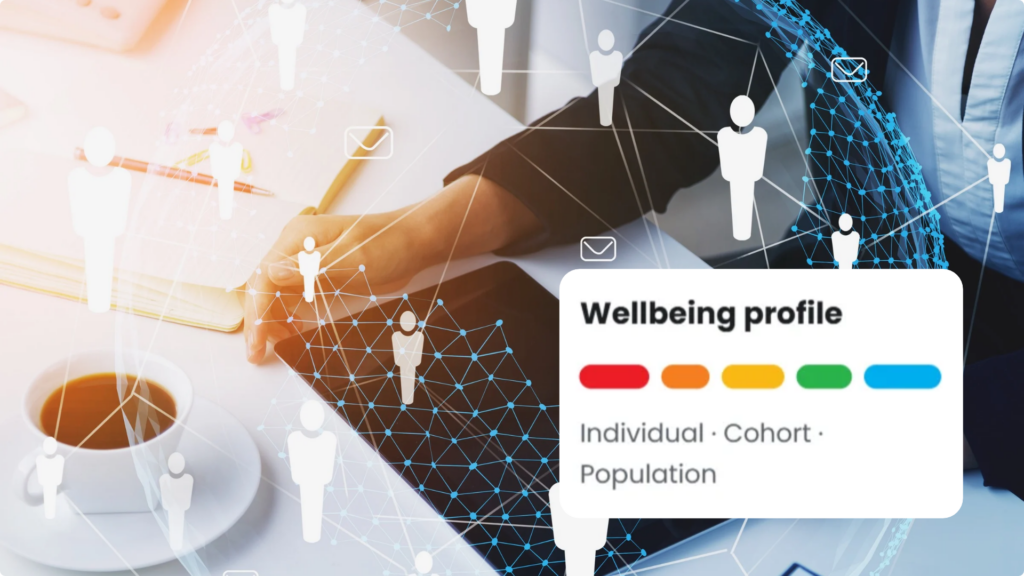
- Directly measured: the organization has a defined measure for the workforce condition itself. For example, if organizational change may be affecting employees’ sense of security or connection, use a holistic workforce wellbeing measure that tracks Safety and Belonging needs across the workforce and over time, rather than trying to infer those conditions from engagement, productivity, or turnover.
- Inferred from a proxy: leadership is using another metric to estimate what may be happening. For example, strong AI adoption or stable performance may be interpreted as evidence that employees are adjusting well, even though neither directly measures security, belonging, workload pressure, or confidence.
- Visible after the outcome: the measure becomes available only after something has already happened, such as rising absence, resignation, quality problems, or a decline in performance.
Then identify which employee conditions matter to the transformation but are still inferred. Where possible, add a consistent direct measure and track it alongside AI adoption and business outcomes.
This gives leadership a better view of what is changing in the workforce while the transformation is still underway, rather than waiting for the consequences to appear.